


Dom Pérignon
pronounced dom peh-ree-NYOHNOne of the first prestige cuvées on sale and one of the best-known names in the world of Champagne. Named after the Benedictine monk from Hautvillers, the wine is made only in good years, always from Chardonnay and Pinot Noir, and first goes on sale after eight or nine years.
See the bottlesAvailable at SZAMPAN.com.pl
27 Champagnes. Formats and packaging of the same bottle are on its page, not listed separately.






House signature
The first prestige cuvée
Dom Pérignon was the first prestige cuvée in history, and the 1921 vintage sailed to New York in 1936 on the liner Normandie.
Only two grape varieties
The wine is made only in good years, always from Chardonnay and Pinot Noir, in proportions that change with the vintage.
Three plénitudes
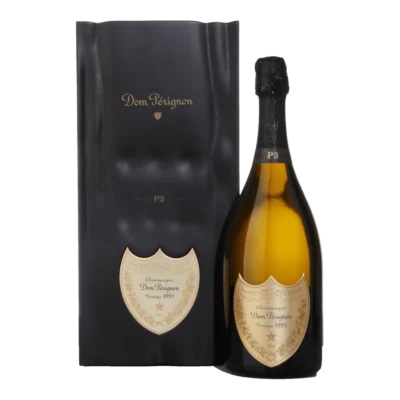
The same vintage returns to the market after 15-20 years on the lees as P2, and after several decades as P3.
At a glance
- Founded
- 1921 (first vintage), on sale since 1936
- Based in
- Épernay and the Abbey of Saint-Pierre in Hautvillers
- Type
- the prestige cuvée of Moët & Chandon, a separate brand since 2004
- Owner
- LVMH (the MHCS company within Moët Hennessy)
- Chef de cave
- Vincent Chaperon (since 1 January 2019)
- Vineyards
- grapes from the group's vineyards: 17 grand cru villages and premier cru Hautvillers
- Production
- not disclosed; estimates range from 5 to 8 million bottles per vintage
- House style
- vintage only, always Chardonnay and Pinot Noir, long ageing on the lees, successive “plénitudes”
Data checked: October 2026.
History
- 1668-1715
The cellarer of Hautvillers
Pierre Pérignon was born in 1638 in Sainte-Menehould, joined the Benedictines at 17, and in 1668 came to the Abbey of Saint-Pierre in Hautvillers as cellarer. He held this post until his death on 14 September 1715, almost half a century. He doubled the abbey's vineyards, had the vines pruned hard, the grapes picked on cool mornings and pressed gently, in several presses. He introduced blending grapes from different vineyards even before pressing. He was buried in the choir of the abbey church, in a place reserved for abbots.
- 1823
An abbey for the Chandons
In 1823 the abbey in Hautvillers was bought by Pierre-Gabriel Chandon, son-in-law of Jean-Rémy Moët, who restored its vineyards. It still belongs to Moët & Chandon and is the spiritual home of the brand. It was here in 2018 that Vincent Chaperon was presented as Richard Geoffroy's successor.
- 1935-1936
300 bottles for an anniversary and the voyage of the Normandie
The house of Mercier handed the Dom Pérignon brand to Moët in 1927 as a gift on the occasion of a family wedding. The idea of a top-tier wine is credited to the Englishman Laurence Venn. In 1935 Moët's British importer, Simon Brothers & Co, received 300 bottles of the 1926 vintage in an old-style bottle for its centenary and gave two each to its 150 best customers. The wine made an impression, so in 1936 the liner Normandie carried 100 cases of the 1921 vintage to New York, now under the name Dom Pérignon.
- 1947-1971
A wine of its own and a rosé for the Shah
Up to the 1943 vintage, Dom Pérignon was in practice a longer-aged Moët vintage, transferred into a special 18th-century-style bottle. From the 1947 vintage it has been made separately from the start. In 1959 the first rosé Dom Pérignon was made, only 306 bottles, which were never sold. In 1971 the Shah of Iran served it at Persepolis at the celebrations of 2,500 years of the Persian Empire.
- 1990-2018
Richard Geoffroy and the “plénitudes”
Richard Geoffroy was chef de cave for 28 years and declared 15 vintages. He described the life of Dom Pérignon as a series of “plénitudes”: the first after around 8-9 years in the cellar, the second after 15-20 years and the third after 30-40. Since 2014 the late-disgorged wines have been called P2 and P3 instead of the former Œnothèque. His last vintage, 2008, was released in 2018, after the 2009 vintage.
- 2019-2026
Vincent Chaperon
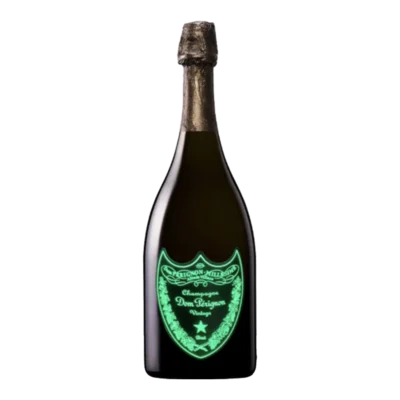
Vincent Chaperon worked alongside Geoffroy from 2005 and co-created the 2005, 2006, 2008 and 2009 vintages. He has been chef de cave since 1 January 2019. In 2026 Dom Pérignon 2017 and the 2009 rosé are on sale. The brand regularly invites artists to design bottles: from Andy Warhol and David Lynch to Lady Gaga, Lenny Kravitz and works by Basquiat for the 2015 vintage.

People
Dom Pierre Pérignon
A Benedictine who looked after the abbey's vineyards and cellars for 47 years. If anything he fought against the bubbles, because secondary fermentation burst the bottles, but his principles of growing, harvesting and blending became the foundation of Champagne. He knew the scholarly monk Dom Thierry Ruinart, who visited Hautvillers.
Laurence Venn
According to Tom Stevenson, it was he who suggested to Moët the idea of a wine above the ordinary vintage, sold in a historic bottle. So was born a category that almost every large house now has.
Richard Geoffroy
He made Dom Pérignon a cult brand among collectors and invented the language of “plénitudes” that the brand uses to describe the wine's ageing.
Vincent Chaperon
Geoffroy's pupil and successor, in the team since 2005. He leads the brand at a time when climate change is altering the character of each new vintage.
House style
Dom Pérignon is always a blend of Pinot Noir and Chardonnay, but the proportions change with the vintage: it has been half and half (rosé 1990), 60% Chardonnay (1982) or 60% Pinot Noir (1969), and only once has Chardonnay exceeded 60% (65% in 1970). The grapes come from the best, sunniest plots in 17 grand cru villages and premier cru Hautvillers.
The wine is made only in good years. From 1921 to 2017 there were around 48 white and 28 rosé vintages. Three vintages in a row were rare (1969-1971, 1998-2000), and five in a row happened only once (2002-2006). Serena Sutcliffe wrote that with age Dom Pérignon takes on aromas of fresh toast and coffee, among the most intriguing in Champagne.
Key cuvées
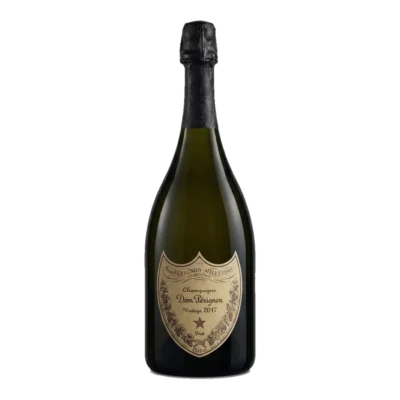
- Dom Pérignon Vintage
- The white vintage, released after around 8-9 years; the 2017 vintage is on sale in 2026.Serving: sushi and sashimi, scallops, lobster, Bresse chicken.
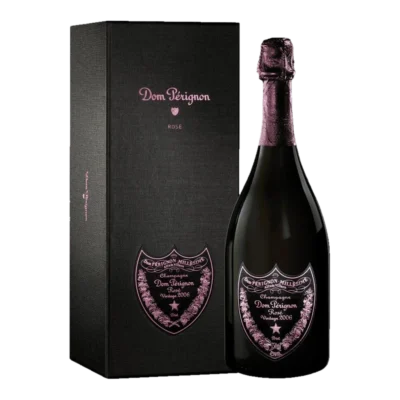
- Dom Pérignon Rosé
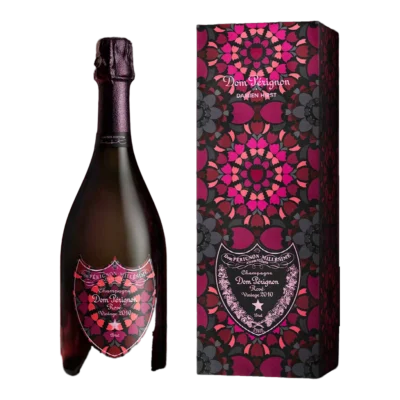
- The rosé version has been made since 1959 and usually comes out a few years after the white; currently the 2009 vintage.Serving: duck, pigeon, tuna, lamb.
- Dom Pérignon Plénitude 2 (P2)
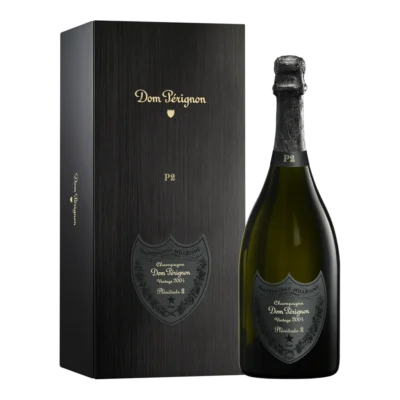
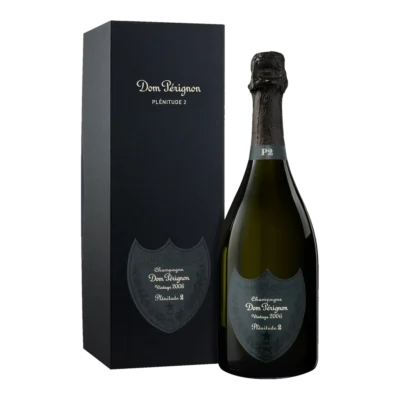
- The same vintage after 15-20 years on the lees, with late disgorgement.Serving: turbot in butter sauce, truffle dishes, aged Parmesan.
- Dom Pérignon Plénitude 3 (P3)
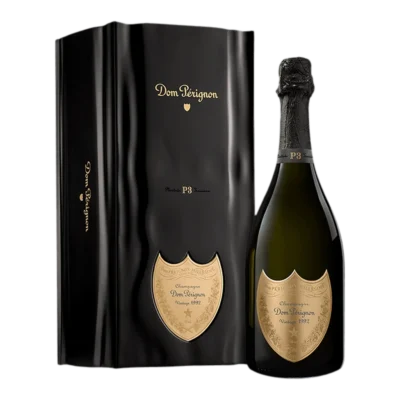
- The third “plenitude”, after several decades in the cellar, in very small quantities.Serving: on its own, in a white wine glass, or with truffle dishes.
Curiosities
- In the film “Dr No” (1962) James Bond goes to smash a bottle of Dom Pérignon '55. Dr No points out the vintage, and Bond puts the bottle down, saying he prefers the '53. source
- In the novel “Moonraker” (1955) Ian Fleming has a waiter recommend “the Dom Pérignon '46” to Bond. No such vintage was ever made. source
- At the wedding of Prince Charles and Lady Diana on 29 July 1981, magnums of Dom Pérignon 1961 were served with a special insignia designed for the occasion. source
- In 2004, at the auction of the Doris Duke collection at Christie's, three bottles of Dom Pérignon 1921 sold for $24,675. source
- In May 2010 Sotheby's in Hong Kong sold 30 bottles and magnums of rosé Œnothèque from six vintages for 1.33 million Hong Kong dollars (approx. 170,000 USD). It is the world record for a single lot of Champagne. source
- In the film “Star Trek: Generations” the starship Enterprise-B is christened with a bottle of Dom Pérignon from the 2265 vintage. source
- anecdote Andy Warhol wrote in his diary in 1981 that in Munich he had met a club of twenty men who bought 2,000 bottles of Dom Pérignon to lock away in a sealed room until the year 2000. The joke was guessing who would live to see it opened. source
- rumour It is persistently repeated that Dom Pérignon was Marilyn Monroe's favourite Champagne. French Wikipedia states this without a source. source
- anecdote The legend of the blind monk grew out of the story that Pérignon tasted grapes without knowing which vineyard they came from. Over time, “blind tasting” turned into blindness. source
Dom Pérignon invented Champagne and after the first sip cried out: “Come quickly, I am drinking the stars!”.
In his day wine from Champagne was mainly still and red, and bubbles were considered a fault because they burst the bottles. Pérignon tried to avoid secondary fermentation. Sparkling Champagne only began to dominate in the middle of the 19th century. The famous line about the stars first appears in a press advertisement from the late 19th century. The monk's real achievements lie elsewhere: discipline in the vineyard, careful pressing and blending of grapes. source
“With age Dom Pérignon takes on a seductive bouquet of fresh toast and coffee, one of the most intriguing scents in Champagne.”

Frequently asked questions
Did Dom Pérignon invent Champagne?
No. In his day the wines of Champagne were mainly still, and bubbles were considered a fault because they burst the bottles. The monk of Hautvillers earned his reputation for other things: discipline in the vineyard, gentle pressing and blending grapes from different plots. The line “I am drinking the stars” comes from an advertisement from the late 19th century.
How does Dom Pérignon differ from Moët & Chandon?
Dom Pérignon is the prestige cuvée of Moët & Chandon, and since 2004 a separate brand within LVMH. Since the 1947 vintage it has been made separately from the start, not as a longer-aged Moët vintage. Unlike Moët Impérial, it is always a vintage wine.
How much does Dom Pérignon cost?
It is the top shelf of Champagne. Old vintages set records at auction: three bottles of the 1921 vintage sold at Christie's in 2004 for $24,675. In May 2010 Sotheby's in Hong Kong sold 30 bottles and magnums of rosé Œnothèque for approx. $170,000, a record for a single lot of Champagne.
What does P2 on a bottle of Dom Pérignon mean?
“Plénitude 2”, the second plenitude: the same vintage, which has spent 15-20 years on the lees and only then been disgorged. The concept was devised by Richard Geoffroy, chef de cave from 1990 to 2018. P3 is the third plenitude, after several decades, in very small quantities.
Which Dom Pérignon vintage is on sale now?
In 2026 the market has the white Dom Pérignon 2017 and the rosé 2009. The white vintage is released after about 8-9 years, the rosé usually a few years later. Since 2019 vintages have been declared by chef de cave Vincent Chaperon.
Other houses
All houses Moët & Chandonpronounced mo-ET ay shahn-DOHN50 bottles
 Bollingerpronounced boh-lan-ZHAY19 bottles
 Krugpronounced kroog13 bottles
 Veuve Clicquotpronounced vuhv klee-KOH11 bottles
 Charles Heidsieckpronounced sharl ED-sik10 bottles
- J-M Sélèquepronounced zhee em seh-LEK10 bottles
- Marguetpronounced mar-GAY10 bottles
 Lansonpronounced lahn-SOHN10 bottles
 Deutzpronounced duhts10 bottles
 Louis Roedererpronounced lwee ROH-duh-rer9 bottles
 Laurent-Perrierpronounced loh-RAHN peh-ree-AY8 bottles
 Ruinartpronounced rwee-NAR8 bottles
Sources
- Dom Pérignon - Wikipedia (EN)
- Dom Pérignon (cuvée) - Wikipedia (FR)
- Dom Pérignon (monk) - Wikipedia (EN)
- De Richard Geoffroy à Vincent Chaperon - LVMH
- Dom Pérignon 2008 release marks the end of an era - Decanter, 2018
- Birthplace of champagne (Hautvillers) - Mission Coteaux, Maisons et Caves de Champagne
- Dom Pérignon's latest harvest... adjusts to the climate crisis - Fortune
- Dom Pérignon - Vintage Archives (domperignon.com)
Photos: Victor Grigas, CC BY-SA 4.0 (Wikimedia Commons); The Crazy Tourist (thecrazytourist.com), CC BY-SA 4.0 (Wikimedia Commons); October Ends, CC BY-SA 3.0 (Wikimedia Commons).


