


Ruinart
pronounced rwee-NARThe oldest house founded specifically to trade in Champagne, it has been based in Reims since 1729. Ruinart is a house of Chardonnay and of chalk-hewn cellars on the Saint-Nicaise hill, which are on the UNESCO World Heritage List.
See the bottlesAvailable at SZAMPAN.com.pl
8 Champagnes. Formats and packaging of the same bottle are on its page, not listed separately.


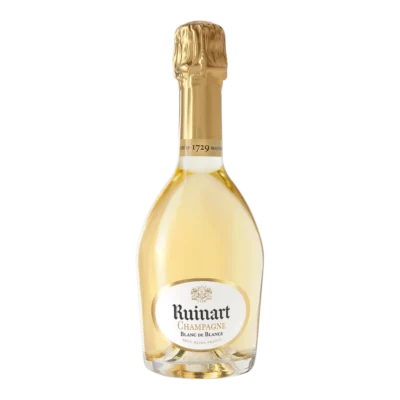


We don't have these bottles at the moment
Leave your e-mail address on the bottle's page and we will let you know when we get it in.
House signature
The first Champagne house
On 1 September 1729 Nicolas Ruinart opened the first trading ledger devoted solely to Champagne.
The house signature
Chardonnay is in every Ruinart wine, including the rosé, and the flagship Blanc de Blancs is made from this grape alone.
The chalk of Saint-Nicaise
The wines age in 8 km of Gallo-Roman chalk quarries, added to the UNESCO World Heritage List in 2015.
At a glance
- Founded
- 1729 (1 September)
- Based in
- Reims, 4 rue des Crayères
- Type
- house (négociant)
- Owner
- LVMH (owned by Moët & Chandon since 1963; company MHCS)
- President
- Frédéric Dufour
- Chef de cave
- Caroline Fiot (since 1 January 2026)
- Vineyards
- the house has historically bought grapes from growers; it does not give the area of its own vineyards
- Production
- not disclosed (2013 catalogue: around 3.5 million bottles)
- House style
- Chardonnay as the house signature, ageing in Gallo-Roman chalk cellars
Data checked: October 2026.
History
- 1728
A monk and a royal edict
Dom Thierry Ruinart (1657-1709) was a Benedictine monk and scholar attached to the Paris abbey of Saint-Germain-des-Prés. He knew Dom Pérignon and visited the abbey at Hautvillers, where he died. He came from a family of cloth merchants in Reims and on his travels saw Champagne win over the courts of Europe. The obstacle was transport: wine could only be shipped in barrels, in which sparkling wine would not survive the journey. Only the edict of Louis XV of 25 May 1728 allowed wine to be transported in bottles.
- 1729
“In the name of God and the Blessed Virgin”
On 1 September 1729 the monk's nephew, Nicolas Ruinart, opened the first account book with the words “In the name of God and the Blessed Virgin, let this book begin”. The first delivery of “wine with bubbles” left in January 1730. At first Champagne was a gift for customers buying cloth, but it soon proved the better business: from 1735 the Ruinarts traded only in wine. They sold most in Lille, which accounted for 67% of turnover.
- 1764
The first rosé in the ledgers
On 14 March 1764 the house's account book recorded a shipment of rosé Champagne to Germany. It is the oldest known record of a sale of rosé Champagne, and the house regards that year as the birth date of its Rosé.
- 1825
Wines, biscuits and hearts
Irénée Ruinart de Brimont (1770-1850), a descendant of the founder, was a member of parliament and mayor of Reims from 1821 to 1827, and gave the house great momentum. As the city's first citizen he welcomed Charles X to Reims for his coronation in 1825 and is said to have declared: “Sire, we offer you our wines, our biscuits and our hearts”. He was the first Vicomte de Brimont.
- 1877-1931
The chalk of Saint-Nicaise
Chalk from the Saint-Nicaise hill was quarried as building stone from Gallo-Roman times until the 18th century. In 1877 Ruinart was one of the first to set up cellars in the old quarries: 8 km of galleries on three levels, with the deepest halls 38 m high. During the First World War it moved production and offices there to shelter from the bombardment of Reims. In 1931 the chalk cellars were listed as a historic monument, and in 2015 the hill and its cellars were added to the UNESCO World Heritage List.
- 1896-1910
Mucha and a flight across the Channel
In 1896 André Ruinart commissioned a poster from Alphonse Mucha, and so began the house's friendship with art that continues to this day. In 1906 Ruinart offered a prize of 12,500 gold francs to the first aviator to fly across the English Channel. Blériot did it in July 1909, but he had not entered the competition, so the prize went on 21 May 1910 to Jacques de Lesseps.
- 1959-2026
From Dom Ruinart to Caroline Fiot
The first vintage of the prestige Dom Ruinart, a Blanc de Blancs, dates from 1959. In 1963 the house was bought by Moët & Chandon, and later it became part of LVMH. From 2007 to 2025 the cellars were run by Frédéric Panaïotis: he brought back ageing Dom Ruinart under cork, in 2020 introduced the paper “second skin” packaging, and in 2023 a new wine, Blanc Singulier. He died in June 2025. Since 1 January 2026 the cellars have been run by his protégée Caroline Fiot. In 2029 the house will celebrate its 300th anniversary.

People
Dom Thierry Ruinart
A monk from the Paris abbey of Saint-Germain-des-Prés who knew Dom Pérignon. He did not found the house, but it was he who passed on to his nephew his knowledge of the wine of Champagne and the conviction that trading in it had a future.
Nicolas Ruinart
A cloth merchant from Reims who on 1 September 1729 opened the first trading ledger in history devoted solely to Champagne. Six years later he gave up cloth.
Frédéric Panaïotis
He came from Veuve Clicquot, where he had worked for about 12 years. Together with chief executive Frédéric Dufour he made Ruinart a house associated with ecology: he planted trees and hedgerows in the vineyards and gave up cardboard boxes. He died on 15 June 2025 in an accident during freediving training in Belgium.
Caroline Fiot
An agronomist and oenologist trained at SupAgro Montpellier and ESSEC, at the house since 2016; she worked alongside Panaïotis for almost ten years. She asks herself what she will leave to the next generations.
House style
The house signature is Chardonnay: every Ruinart wine, even the rosé, has it in the blend, and the flagship Blanc de Blancs is made from this grape alone. Ruinart has been a négociant from the start and buys grapes from growers, formerly from around 70 estates around Reims, including Cormontreuil, Taissy, Brimont and Hautvillers.
The wines age in chalk cellars at a constant 10-12 °C: non-vintage wines for up to three years, vintages for five, and Dom Ruinart for about ten. The bottle's shape recalls the first Champagne bottles of the 18th century. Since 2020 the house has packed its bottles in a “second skin”, a moulded paper case that is fully recyclable, and since the same year it has planted more than 20,000 trees in the vineyards.
Key cuvées
- Ruinart Blanc de Blancs
- The house's calling card since 2001, 100% Chardonnay.Serving: oysters, scallops, sushi, fish with lemon butter.
- Ruinart Rosé
- A rosé Champagne whose history the house dates from the 1764 shipment.Serving: salmon, tuna, duck, red fruit.
- R de Ruinart
- A Brut from Chardonnay and Pinot Noir, in non-vintage and vintage versions.Serving: as an aperitif, with prawns, roast chicken and soft cheeses.
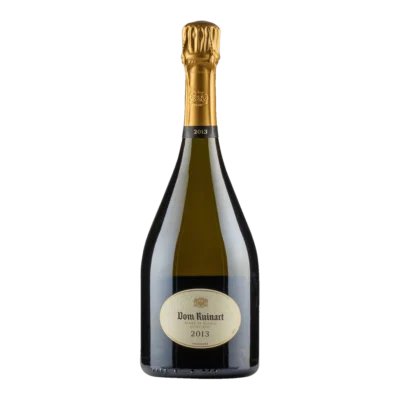
- Dom Ruinart Blanc de Blancs
- A prestige vintage from Chardonnay alone, first made in 1959, about ten years in the cellar.Serving: lobster, caviar, sole cooked in butter.
- Dom Ruinart Rosé
- The same Blanc de Blancs with some red wine from Pinot Noir, first sold in 1962.Serving: pigeon, lamb, beef carpaccio.
- Ruinart Blanc Singulier
- A Chardonnay Champagne introduced in 2023, meant to show how the climate changes from year to year.Serving: oysters, ceviche, fish tartare.
Curiosities
- Alphonse Mucha's 1896 poster for Ruinart is today one of the icons of Art Nouveau and has entered the public domain. Mucha was hired by André Ruinart. source
- On Louis Tauzin's 1914 poster the house praised its cellars as “the most picturesque in Champagne” and invited visitors to tour them without a ticket. source
- Ruinart and Veuve Clicquot have different “first rosés”. Ruinart recorded a shipment of rosé Champagne in 1764. In 1818 Madame Clicquot was the first to make rosé Champagne by adding red wine from Bouzy to white, the method most houses use today. source
- In 1906 Ruinart offered a prize for the first flight across the English Channel. Louis Blériot was the first to fly across, but he had not entered, so the prize went to Jacques de Lesseps, who flew across the Channel on 21 May 1910. source
- anecdote The greeting with which the mayor of Reims received Charles X in 1825, “we offer you our wines, our biscuits and our hearts”, has gone down in Reims history. The biscuits are the famous pink biscuits de Reims, which are dipped in Champagne. source
- In January 1906 the house advertised in the American weekly “The Wasp” as the firm of “seven generations of Ruinarts”. source
- On 5 October 2024 the house opened its redesigned garden on rue des Crayères to visitors: 7,000 m² of plants and sculptures by contemporary artists. source
- Frédéric Panaïotis died aged 60 during freediving training in Rochefontaine, Belgium. According to reports, he unclipped from the line on his second descent to 25 metres. source
Ruinart is the oldest wine producer in Champagne.
Ruinart is the oldest house founded to trade in Champagne, that is, sparkling wine (1729). Gosset of Aÿ has an older lineage, with roots going back to 1584, but Pierre Gosset made still wines at the time, mainly red. So both titles are true; they simply refer to different things. source
“Sire, we offer you our wines, our biscuits and our hearts.”

Frequently asked questions
Is Ruinart the oldest Champagne house?
Yes, it is the oldest house founded to trade in Champagne, that is, sparkling wine: since 1729. Gosset of Aÿ has an older lineage, going back to 1584, but at the time it made still wines, mainly red. Both titles are true; they simply refer to different things.
Which Ruinart should you start with?
Ruinart Blanc de Blancs, the house's calling card since 2001, made entirely from Chardonnay: fresh, citrusy, good with seafood. If you prefer a fuller Champagne for an aperitif, choose R de Ruinart, from Chardonnay and Pinot Noir.
How does Ruinart Blanc de Blancs differ from R de Ruinart?
Blanc de Blancs is Chardonnay alone, lighter and more mineral. R de Ruinart combines Chardonnay with Pinot Noir, so it has more body and fruit; it comes in non-vintage and vintage versions. Both carry the house signature, Chardonnay.
What are the Ruinart Crayères cellars?
They are old chalk quarries on the Saint-Nicaise hill in Reims, worked since Gallo-Roman times. In 1877 Ruinart set up cellars in them: 8 km of galleries on three levels, with halls up to 38 m high. They have been a listed monument since 1931 and on the UNESCO World Heritage List since 2015.
Who is the Ruinart chef de cave?
Since 1 January 2026, Caroline Fiot, an agronomist and oenologist, at the house since 2016. For almost ten years she worked alongside Frédéric Panaïotis, who ran the cellars from 2007 and died in June 2025. It was he who introduced the paper “second skin” packaging and Blanc Singulier.
Other houses
All houses Moët & Chandonpronounced mo-ET ay shahn-DOHN50 bottles
 Dom Pérignonpronounced dom peh-ree-NYOHN27 bottles
 Bollingerpronounced boh-lan-ZHAY19 bottles
 Krugpronounced kroog13 bottles
 Veuve Clicquotpronounced vuhv klee-KOH11 bottles
 Charles Heidsieckpronounced sharl ED-sik10 bottles
 Lansonpronounced lahn-SOHN10 bottles
- Marguetpronounced mar-GAY10 bottles
- J-M Sélèquepronounced zhee em seh-LEK10 bottles
 Deutzpronounced duhts10 bottles
 Louis Roedererpronounced lwee ROH-duh-rer9 bottles
 Laurent-Perrierpronounced loh-RAHN peh-ree-AY8 bottles
Sources
- Ruinart (Champagne) - Wikipedia (EN)
- Champagne Ruinart - Wikipedia (FR)
- Irénée Ruinart de Brimont - Wikipedia (FR)
- Ruinart - LVMH
- Nos caves - ruinart.com
- Remembering Ruinart cellar master Frédéric Panaïotis - The Drinks Business, 2025
- Champagne : Ruinart nomme sa nouvelle cheffe de caves - Journal du Luxe, 2025
- Caroline Fiot, ovvero come ti guido col sorriso la più antica maison - Milano Finanza, 2026
- À Reims, Ruinart ouvre les portes de son jardin - Numéro, 2024
- Dom Pérignon (monk) - Wikipedia (EN)
- Champagne Gosset - Wikipedia (EN)
Photos: Alphonse Mucha, public domain (Wikimedia Commons); Louis Tauzin, public domain (Wikimedia Commons); Gérald Garitan, CC BY-SA 4.0 (Wikimedia Commons).


