


Lanson
pronounced lahn-SOHNOne of the oldest houses in Champagne, with a Maltese cross on its label and a British Royal Warrant since the time of Queen Victoria. Lanson is known for an approach rare among large houses: most of its wines do not go through malolactic fermentation, so they are crisp and long-lived.
See the bottlesAvailable at SZAMPAN.com.pl
10 Champagnes. Formats and packaging of the same bottle are on its page, not listed separately.




House signature
The Maltese cross
The house was founded by François Delamotte, and the cross seen on every bottle was given to it in 1798 by his son, a Knight of Malta.
Freshness that lasts
Most of the wines do not go through malolactic fermentation, so they are crisp and age very well.
At a glance
- Founded
- 1760 (as Delamotte), the Lanson name since 1837
- Based in
- Reims, rue de Courlancy
- Type
- house (négociant-manipulant)
- Owner
- the Lanson-BCC group (since 2006)
- President
- François Van Aal (president of Champagne Lanson)
- Chef de cave
- Hervé Dantan (with the house since 2013, chef de cave since 2015)
- Vineyards
- approx. 57 ha of its own, the rest bought in
- Production
- approx. 5 million bottles a year
- House style
- freshness and tension: traditionally no malolactic fermentation, plenty of Pinot Noir and Chardonnay, long ageing
Data checked: October 2026.
History
- 1760
A judge from Reims
François Delamotte, a judge from Reims, founds a Champagne trading house in a town house on the corner of rue Cérès and rue des Marmousets. The family coat of arms bears the motto “Vive et me ama” - live and love me. With his son Alexandre he runs the firm Delamotte Père & Fils.
- 1798
A knight from Malta
When Bonaparte captures Malta and dissolves the Order of St John, the founder's younger son, Nicolas-Louis Delamotte, a Knight of Malta, returns to Reims and joins the firm. He adopts the Maltese cross as a trademark. That cross still adorns every bottle of Lanson.
- 1837
A pact between two families
Jean-Baptiste Lanson, a family friend and from 1828 a partner of the Delamottes, takes over the house after the death of Nicolas-Louis under an agreement between the families and renames it J-B Lanson et Compagnie. His sons Victor-Marie and Henri join the firm. By 1833 the house was already making rosé Champagne, one of the first to do so.
- 1900
At the courts of Europe
In 1882 Victor-Marie Lanson signs an agreement with the London firm Percy Fox that will last a hundred years. In 1900 Queen Victoria grants Lanson a Royal Warrant, which the house still holds. Later come appointments as supplier to the Spanish and Swedish courts.
- 1937
The black label
Victor Lanson, who rebuilt the ruined firm after the war and bought more vineyards, wants to promote a non-vintage Brut. In honour of its first market, Britain, he gives it an English name: Black Label. In 1927 he had taken over the buildings and cellars of the house of Binet on rue de Courlancy, where Lanson is still based today.
- 1975
A carousel of owners
The family sells the house to the Gardinier group; it then passes to BSN (the future Danone), and in 1991 to LVMH, which after three months sells the brand on to Marne et Champagne while keeping 203 ha of vineyards. In 2004 it is rescued by Caisse d'Épargne, and in 2006 it is bought by the Boizel Chanoine Champagne group, renamed Lanson-BCC in 2010.
- 2015
Dantan and Clos Lanson
Hervé Dantan, after 22 years at the Mailly Grand Cru cooperative, arrives in 2013 and in 2015 takes over from Jean-Paul Gandon. He builds a new press house and introduces casks and a small proportion of wines that have gone through malolactic fermentation. The emblem of the new era is Clos Lanson, a one-hectare walled vineyard in the centre of Reims, bottled as a separate wine since 2006.

People
Nicolas-Louis Delamotte
He returned from Malta in 1798 and gave the house a symbol that has survived every change of name and owner.
Jean-Baptiste Lanson
A friend of the Delamottes who gave the house its name. The Lanson family ran the firm until it was sold to the Gardinier group (sources give either 1975 or 1980).
Victor Lanson
He rebuilt the firm after the First World War, bought vineyards when others were selling them, and in 1937 created Black Label. He won the house appointments as supplier to the courts of Spain and Sweden.
Hervé Dantan
The son of winegrowers from near Vitry-le-François, trained as an oenologist in Reims. He shuns the limelight and insists that the brand matters most. He dared to touch the house's sacred rules to add complexity to Black Label.
House style
Lanson has always made its wines without malolactic fermentation. As a result they retain sharper acidity and fruit; when young they can be austere, but they age superbly. Hervé Dantan sticks to this principle, but in blends such as Rosé Création he adds a small proportion of wines that have gone through malolactic fermentation and a little wine from casks. The blends are based on Pinot Noir and Chardonnay.
The house has about 57 ha of its own vineyards and buys in the rest of its grapes. The cellars cut into the chalk run for about 7 kilometres and hold nearly 20 million bottles. Beneath Clos Lanson the house has set up 20 galleries for its collection of old vintages: about 200,000 bottles, the oldest dating from 1904.
Key cuvées
- Le Black Création
- The successor to Black Label: a non-vintage Brut based on Pinot Noir and Chardonnay, which Hervé Dantan composes afresh every year.Serving: as an aperitif, with oysters, prawns and grilled fish.
- Le Rosé Création
- A rosé with rosé reserve wines and a touch of red wine from Bouzy and Les Riceys. The number on the label is the number of blends since the first Rosé in 1952.Serving: salmon, tuna, duck, strawberries.
- Le Green Label
- Brut from organically grown grapes.Serving: sushi, salads, goat's cheese, grilled vegetables.
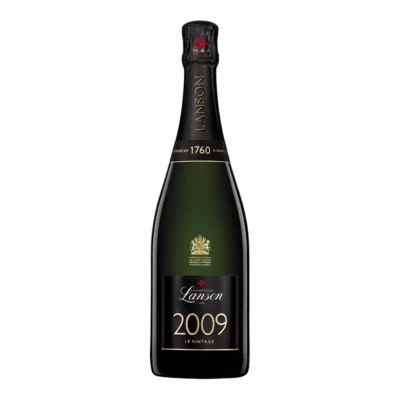
- Le Vintage
- Vintage, in the house style: long ageing and freshness without malolactic fermentation.Serving: lobster, scallops, chicken in cream sauce.
- Clos Lanson
- Pure Chardonnay from a one-hectare clos in the centre of Reims, fermented in casks. The grapes are picked by the house's own staff.Serving: turbot, sole cooked in butter, langoustines, aged Comté.
- Noble Cuvée
- The house's prestige line, in Brut and Blanc de Blancs versions.Serving: caviar, lobster, truffle dishes.
Curiosities
- The Maltese cross on the label is a reminder of Nicolas-Louis Delamotte, a knight of the order who returned to Reims when Bonaparte took Malta. source
- Lanson has held a British Royal Warrant since 1900, since the days of Queen Victoria. source
- The 1882 agreement with the London firm Percy Fox lasted a whole century. source
- anecdote The collection of old vintages holds bottles going back to 1904, and the chefs de cave's records even mention an 1874 vintage. Richard Juhlin admitted that it took a 15-year-old Noble Cuvée and Lanson 1979 to convince him how good Lanson can be. source
- Clos Lanson sits on 30 metres of crumbly chalk covered by a thin layer of soil, and the walls and the city raise the temperature of the plot. Half the vines were planted in 1961, the other half after the frosts of January 1985. source
- In the courtyard of the headquarters on rue de Courlancy stands a bronze copy of Joseph Chinard's “Carabinier” from the Arc de Triomphe du Carrousel in Paris. source
- In January 2026 the Lanson-BCC group bought the house of Heidsieck & Co Monopole for 50 million euros. source
Lanson is a house founded by the Lanson family.
The house was founded in 1760 by François Delamotte. Jean-Baptiste Lanson became a partner in 1828, and the firm only took the name J-B Lanson et Compagnie in 1837. The Delamotte name lives on in a separate house in Le Mesnil-sur-Oger, today a sister house of Salon. source
“The brand is what matters most. Don't get me wrong, I'm proud to be a winemaker. But when I make Champagne, I think first and foremost of my parents and my region.”


Frequently asked questions
Why is there a Maltese cross on a bottle of Lanson?
It is a reminder of Nicolas-Louis Delamotte, the founder's son and a Knight of the Order of Malta. When Bonaparte took Malta in 1798, the knight returned to Reims, joined the family firm and adopted the cross as a trademark. It has survived every change of name and owner.
Was the Lanson house founded by the Lanson family?
No. The house was founded in 1760 by the Reims judge François Delamotte. Jean-Baptiste Lanson became a partner in 1828, and the firm only took the name J-B Lanson et Compagnie in 1837.
Why does Lanson avoid malolactic fermentation?
Because the house has always focused on freshness: without malolactic fermentation the wine keeps sharper acidity and fruit. This can make it austere when young, but it ages superbly; the house collection holds vintages going back to 1904. Chef de cave Hervé Dantan now adds a small proportion of wines that have gone through malolactic fermentation and of cask-aged wines to some blends.
Which Lanson should you start with?
Le Black Création, the successor to the famous Black Label of 1937: a non-vintage Brut based on Pinot Noir and Chardonnay, which Hervé Dantan composes afresh every year. If you are looking for a rosé, choose Le Rosé Création; if you want an organic wine, Le Green Label.
What is Clos Lanson?
A one-hectare walled vineyard right in the centre of Reims, bottled as a separate wine since 2006. It is pure Chardonnay, fermented in casks, and the grapes are picked by the house's own staff. The vines grow on 30 metres of chalk, and the walls and the city raise the temperature of the plot.
Other houses
All houses Moët & Chandonpronounced mo-ET ay shahn-DOHN50 bottles
 Dom Pérignonpronounced dom peh-ree-NYOHN27 bottles
 Bollingerpronounced boh-lan-ZHAY19 bottles
 Krugpronounced kroog13 bottles
 Charles Heidsieckpronounced sharl ED-sik10 bottles
 Veuve Clicquotpronounced vuhv klee-KOH11 bottles
 Deutzpronounced duhts10 bottles
- Marguetpronounced mar-GAY10 bottles
 Louis Roedererpronounced lwee ROH-duh-rer9 bottles
- J-M Sélèquepronounced zhee em seh-LEK10 bottles
 Ruinartpronounced rwee-NAR8 bottles
 Laurent-Perrierpronounced loh-RAHN peh-ree-AY8 bottles
Sources
- Wikipedia FR: Champagne Lanson
- Wikipedia EN: Champagne Lanson
- Essi Avellan: Hervé Dantan, chef de cave of Lanson (Flacons)
- Champagne Club: Lanson Vintage Collection (2025)
- Lanson: Le Rosé Création
- EasyBourse: Lanson-BCC finalise une acquisition (2026)
Photos: Phsmet, CC BY-SA 4.0 (Wikimedia Commons); Phsmet, CC BY-SA 4.0 (Wikimedia Commons); G.Garitan, CC BY-SA 3.0 (Wikimedia Commons); Phsmet, CC BY-SA 4.0 (Wikimedia Commons).


