


Le Mesnil
pronounced luh may-NEELA cooperative from the village that many consider the best place for Chardonnay in the world. Most of its wine is bought by the big houses, and only a small part is bottled under its own Le Mesnil label, sold at a fraction of the price of its neighbours on the same chalk.
See the bottlesAvailable at SZAMPAN.com.pl
6 Champagnes. Formats and packaging of the same bottle are on its page, not listed separately.



House signature
One village
The members' 324 ha lie exclusively in Le Mesnil-sur-Oger, where the Chardonnay roots go straight down into the chalk.
Growers in the cooperative
The cooperative was founded in 1937 by growers from Le Mesnil, driven by the crisis, and today it has 784 members.
A library of vintages
Unlike many cooperatives, Le Mesnil keeps old vintages, the oldest from the 1969 harvest.
At a glance
- Founded
- 1937
- Based in
- Le Mesnil-sur-Oger (Grand Cru), Côte des Blancs
- Type
- cooperative (Union des Propriétaires Récoltants, UPR), a member of Union Champagne
- Owner
- the cooperative's members: 784 growers (cooperative figures from 2021)
- President
- Eric Landreat (management according to the Union Champagne website); previously Francis Amillet
- Vineyards
- the members' 324 ha (2021), exclusively in the Grand Cru of Le Mesnil-sur-Oger
- Production
- cellars for 7.4 million bottles, vats holding 81,807 hl; only a small part of the harvest is bottled under the Le Mesnil brand
- House style
- pure Chardonnay from the chalk of Le Mesnil, steel and concrete, at least three years in the cellar, a wine library with vintages back to 1969
Data checked: October 2026.
History
- 1937
A cooperative on the Henriot site
The cooperative was founded in 1937 by a group of growers from Le Mesnil-sur-Oger, driven by the crisis of the 1930s. They bought land and buildings from the house of Henriot, on the corner of rue Charpentier Laurain and the road to Vertus. The first president was Henri Robert. A single press and a few vats got them through the war.
- 1950-1963
Services for the neighbours
From 1950 to 1955 the cooperative was run by its president Joseph Vizeneux with René Robert, the founder's son. Three presses and vats for about 7,000 hl were added. Other cooperatives sent pressing, tirage and disgorgement work to Le Mesnil, so in 1959-1963 cellars, a cellier and three 4,000 kg presses were added.
- 1966
The birth of Union Champagne
The cooperatives Les Grappes d'Or of Oger, Coopérative Vinicole of Vertus and Louis Dupont of Cumières pooled their harvests in the UPR buildings in Le Mesnil. When space ran out, in 1966 they bought buildings in Avize within 48 hours and founded Union Champagne, a cooperative of cooperatives. That same year the president, Michel Amillet, was killed in an accident.
- 1970
A record harvest and the “Mabile” building
In 1970 the average yield reached 17,777 kg per hectare. The cooperative hastily put up a building with eight 6,000 kg Mabile presses and vats for 14,000 hl. In 1984 two levels of cellars for 2 million bottles were added, and in 1998-1999 eight Péra presses and three more levels of cellars.
- 2001-2026
The Gilles Marguet era
In January 2001 Gilles Marguet became director. Under the presidency of Dominique Babé (2000-2014) the cooperative was modernised. In 2021 it had 784 members, 324 ha and a turnover of over 28 million euros. The range now includes eight cuvées.

People
Gilles Marguet
He succeeded Jean-Louis Leboeuf. The British importer Dreyfus Ashby writes that in 1994 Marguet worked a harvest in South Africa, in Stellenbosch, and that he is a keen amateur pilot.
Henri Robert
He led the cooperative in its early years. His son René co-managed it in the 1950s.
Odile Launois
She took over the cooperative after the tragic death of Michel Amillet. During her presidency the “Mabile” building and the 1984 cellars were built.
House style
Le Mesnil-sur-Oger has 420 ha of vineyards, all classified as grand cru. The topsoil here is very thin, so the Chardonnay roots go straight down into Cretaceous chalk. This gives wines with sharp acidity in youth and a long life. On the east-facing slopes almost nothing but Chardonnay is grown.
The cooperative ferments its wines in steel and concrete vats at about 18 °C. In the Brut, typically 90% is wine from the current vintage and 10% reserve wines. The bottles spend at least three years on the lees, and the dosage is about 7 g/l. The Sublime rosé is made from Le Mesnil Chardonnay and Pinot Noir bought from a grand cru cooperative in the Montagne de Reims.
What sets Le Mesnil apart from other cooperatives is its wine library: the cooperative keeps old vintages, the oldest harvested in 1969. With age, Le Mesnil Chardonnay moves from citrus and chalk to roasted almond, mocha and undergrowth.
Key cuvées
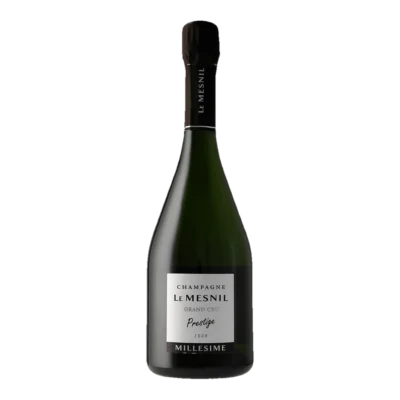
- Le Mesnil Blanc de Blancs Grand Cru (Brut)
- The cooperative's core Champagne, pure Chardonnay from a single grand cru village. Gault&Millau rates it 91/100.Serving: oysters, sushi, fish with lemon butter, goat's cheese.
- Sublime Rosé
- About 50% Chardonnay, 35% Pinot Noir and 15% red wine, three to four years on the lees.Serving: salmon, tuna tartare, duck.
- Sublime Millésime (2015, 2017, 2019)
- A vintage Grand Cru Blanc de Blancs, also released in magnum.Serving: scallops, lobster, sole cooked in butter.
- Cœur de Mesnil 2012
- The most expensive cuvée in the range, a vintage Chardonnay from the heart of the village.Serving: turbot, caviar, aged Comté.
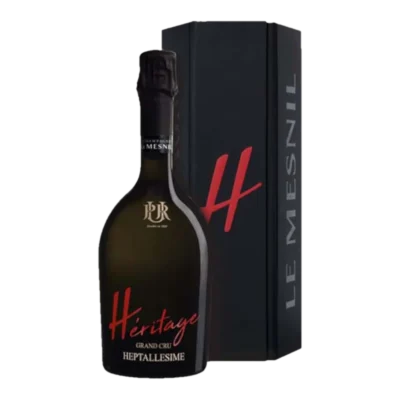
- Héritage
- A Grand Cru made from many vintages, described in the cooperative's shop as a “heptallésime”.Serving: chicken in cream sauce, mushrooms, mature Comté.
Curiosities
- The Le Mesnil cooperative was at the origins of Union Champagne: three neighbouring cooperatives brought their harvests to it, and when space ran out they bought buildings in Avize within 48 hours. Union Champagne is the source of the De Saint Gall brand, which we also stock. source
- According to the importer Dreyfus Ashby, UPR bottles less than 10% of its production under its own brand. The rest of the wine is bought by the large houses. source
- In the record year of 1970 the average yield in Le Mesnil was 17,777 kg per hectare, so the cooperative hastily put up a building with eight presses. source
- Of the 420 ha in Le Mesnil, about 320 ha belong to growers, and more than 80 of them sell their own Champagne. The rest of the vineyards belong to the large houses. source
- The cooperative makes Champagne for the own label of the London merchant Berry Bros. & Rudd. Jancis Robinson described it as “Union des Propriétaires Récoltants Le Mesnil, Berry Bros & Rudd Blanc de Blancs Grand Cru”. source
- In 1970 the yield in Le Mesnil was so high that the cooperative put up an entire building with eight presses in a single season. In its chronicle it is simply called the “Mabile” building, after the make of the presses. source
- The cooperative also sells Coteaux Champenois and ratafia from Le Mesnil, and a function room can be hired in its buildings. source
Cooperative Champagne is always a lesser category of wine than Champagne from a grower or a large house.
In Le Mesnil the cooperative has access to the same chalky grand cru slopes as Salon or Krug, and its base wines are bought by the large houses. A British importer writes that some critics call UPR a factory because of its scale, but the quality of its base wines is not in doubt. source

Frequently asked questions
Why is Le Mesnil Champagne cheaper than its neighbours' Champagnes?
Because it is a cooperative that sells most of its wine to the large houses and bottles only a small part under its own label. The chalk and the Chardonnay are the same as at the village's most famous producers, but the price is a fraction of theirs.
Is cooperative Champagne inferior?
Not necessarily. In Le Mesnil the cooperative has access to the same chalky grand cru slopes as Salon or Krug, and its base wines are bought by the large houses. Gault&Millau rates its core Blanc de Blancs 91/100.
Which Le Mesnil Champagne should you start with?
Le Mesnil Blanc de Blancs Grand Cru: pure Chardonnay from a single village, at least three years on the lees, about 7 g/l of sugar. It is a lesson in the chalky Le Mesnil style at a sensible price. For a special occasion there is the vintage Sublime Millésime.
How much wine does the cooperative bottle under its own brand?
A small part: according to the British importer Dreyfus Ashby, less than 10% of production. The rest of the wine is bought by the large houses.
How does Le Mesnil Champagne age?
Very well. When young it has sharp acidity, citrus and chalk, and with age it moves towards roasted almond, mocha and undergrowth. That is why the cooperative keeps a library of old vintages, the oldest from 1969.
Other houses
All houses Moët & Chandonpronounced mo-ET ay shahn-DOHN50 bottles
 Dom Pérignonpronounced dom peh-ree-NYOHN27 bottles
 Bollingerpronounced boh-lan-ZHAY19 bottles
 Krugpronounced kroog13 bottles
 Charles Heidsieckpronounced sharl ED-sik10 bottles
 Veuve Clicquotpronounced vuhv klee-KOH11 bottles
 Deutzpronounced duhts10 bottles
 Lansonpronounced lahn-SOHN10 bottles
- Marguetpronounced mar-GAY10 bottles
 Louis Roedererpronounced lwee ROH-duh-rer9 bottles
- J-M Sélèquepronounced zhee em seh-LEK10 bottles
 Ruinartpronounced rwee-NAR8 bottles
Sources
- Champagne Le Mesnil - cooperative website
- Champagne Le Mesnil - Qui sommes-nous
- Union Champagne - UPR Le Mesnil, history and figures
- Union Champagne - UPR Le Mesnil, management
- Union Champagne - Notre histoire
- Dreyfus Ashby - Champagne Le Mesnil, Mesnil-sur-Oger
- Gault&Millau - Le Mesnil
- Jancis Robinson - UPR Le Mesnil, Berry Bros & Rudd Blanc de Blancs Grand Cru
- Wikipedia FR - Le Mesnil-sur-Oger
Photos: Diliff, CC BY-SA 3.0 (Wikimedia Commons); October Ends, CC BY-SA 3.0 (Wikimedia Commons); Szeder László, CC BY-SA 4.0 (Wikimedia Commons).


