


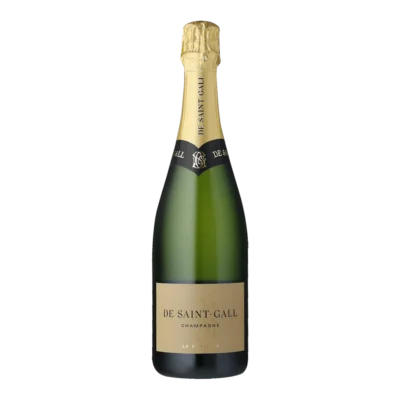
De Saint Gall
pronounced duh san GALThe brand of a union of cooperatives that owns the highest-classified vineyards in Champagne. Behind the De Saint Gall label stand more than two thousand growers from the best villages of the Côte des Blancs and the Montagne de Reims, including the cooperative from Le Mesnil-sur-Oger.
See the bottlesAvailable at SZAMPAN.com.pl
4 Champagnes. Formats and packaging of the same bottle are on its page, not listed separately.



House signature
Over 2,300 growers
Union Champagne brings together 15 cooperatives and around 2,330 members, and 90% of their vineyards are in grand cru and premier cru villages.
Goldsmiths of Chardonnay
Around 800 ha are Chardonnay from Avize, Cramant, Oger, Le Mesnil-sur-Oger and Vertus, and a third of the range is Blanc de Blancs.
Four grand crus
A vintage Blanc de Blancs from Le Mesnil, Oger, Avize and Cramant, made only in the best years and aged in the cellar for more than a decade.
At a glance
- Founded
- 1966 (Union Champagne)
- Based in
- Avize, Côte des Blancs
- Type
- cooperative (a brand of Union Champagne, a union of 15 cooperatives)
- Owner
- Union Champagne: 15 cooperatives, around 2,330 members
- Chef de cave
- Cédric Jacopin
- Vineyards
- around 1,420 ha, 90% of it in Grand and Premier Cru villages; around 800 ha of Chardonnay
- House style
- Chardonnay from the Côte des Blancs, Blanc de Blancs as the core of the range, the prestige Orpale from four grand cru villages
Data checked: October 2026.
History
- before 1966
Three cooperatives in someone else's cellar
The cooperatives Les Grappes d'Or from Oger, Coopérative Vinicole from Vertus and Louis Dupont from Cumières brought their harvests to the buildings of the Union des Propriétaires Récoltants in Le Mesnil-sur-Oger. The harvests grew, and space ran out.
- 1966
A decision in 48 hours
In Avize, buildings with 8,000 m² of cellars came up for sale. The cooperatives decided within 48 hours and bought them. That is how Union Champagne was founded in 1966: a cooperative of cooperatives that stored and vinified the wines of the four founding cooperatives.
- 1966-today
Fifteen cooperatives
More cooperatives joined the union: from Ambonnay, Avenay-Val-d'Or, Aÿ, Bergères-les-Vertus, Bouzy, Cramant, Grauves, Oger and Villers-Marmery. Fourteen of the fifteen operate in Premier and Grand Cru villages. Unusually for Champagne, all of them hand their entire harvest over to the union.
- 2013
A new winery in Avize
In 2013 Union Champagne opened new facilities in Avize. Each cooperative vinifies its own grapes, and the chef de cave assembles the De Saint Gall blends from them on site in Avize.
- 2022-2025
Orpale with no dosage and the Drinks International ranking
In 2022 the house released Orpale 2002 with no dosage for the first time, for the vintage's twentieth anniversary. The cuvée Le Blanc de Bio followed in 2024. In 2025 De Saint Gall came 37th in Drinks International magazine's ranking “The World's Most Admired Champagne Brands”.

People
Cédric Jacopin
He puts together a range of around ten cuvées, a third of which are Blanc de Blancs. He said of the 2002 vintage that it was a sunny, distinctive year that should be expressed in its purest form, that is, with no dosage.
House style
The union members' vineyards cover around 1,420 ha, 90% of which lie in Grand and Premier Cru villages. Around 800 ha are Chardonnay, mainly from the Côte des Blancs: Avize, Cramant, Oger, Le Mesnil-sur-Oger, Vertus. The Pinot Noir comes from the Montagne de Reims and the Vallée de la Marne, from Ambonnay, Bouzy, Aÿ and Cumières. The house calls its growers “goldsmiths of Chardonnay”.
The Avize winery holds 8,500 hl of reserve wines in steel and 980 hl in wooden vats, has a bottling line for 12,000 bottles an hour and cellars for 25 million bottles. Since 2012 the union has run a sustainable viticulture programme, and over half of the vineyards are VDC or HVE 3 certified.
The style is pure and chalky. Le Blanc de Blancs Grand Cru combines lemon, green apple and almond, while Le Tradition Premier Cru adds Pinot Noir to the Chardonnay. At the top stands Orpale, a vintage Blanc de Blancs from four grand cru villages, made only in the best years and kept in the cellars for more than a decade.
Key cuvées
- Orpale
- A vintage Blanc de Blancs Grand Cru from Le Mesnil-sur-Oger, Oger, Avize and Cramant, more than ten years in the cellar. Orpale 2012 Extra Brut: 91/100 Gault&Millau.Serving: lobster, turbot in butter sauce, scallops, aged Comté.
- Le Blanc de Blancs Grand Cru
- Pure Chardonnay from the Grand Cru villages of the Côte des Blancs; the 2017 vintage was given 91/100 by Gault&Millau.Serving: oysters, sushi, grilled fish, goat's cheese.
- Le Tradition Premier Cru
- A blend of Chardonnay and Pinot Noir from premier cru vineyards.Serving: as an aperitif, with prawns, roast chicken and quiche.
- Le Sélection
- A Blanc de Blancs Premier Cru, lighter and more citrusy.Serving: as an aperitif, with fish tartare, prawns and salads.
- Le Blanc de Bio
- An Extra Brut Premier Cru made from organically grown Chardonnay, in the range since 2024.Serving: oysters, ceviche, sashimi.
- Le Demi-Sec
- A medium-sweet premier cru Champagne made from Chardonnay and Pinot Noir.Serving: lemon tart, fresh fruit, foie gras, mildly spicy Asian food.
Curiosities
- Union Champagne was born in the buildings of the cooperative in Le Mesnil-sur-Oger, whose Le Mesnil Champagne our shop also sells. UPR Le Mesnil is still one of the union's fifteen cooperatives today. source
- Union Champagne ranks first among Champagne cooperative unions for the classification of its vineyards and third for production. source
- The union's fifteenth cooperative, Les Coteaux de Champagne from Oger, takes only members' grapes from outside the Premier and Grand Cru villages. This means the De Saint Gall brand uses only grand cru and premier cru plots. source
- Orpale 2002 with no dosage was sealed with wax, and its case was made less than 100 km from the cellars in Avize. source
- The Union Champagne board has over 30 members from 15 cooperatives, and its executive committee is made up of the fifteen presidents of the member cooperatives and the president of the union. source
- Orpale 2004 was included in Wine List Confidential's selection “Nine outstanding Champagnes over £50”. source
A large cooperative means anonymous grapes from just any old plots.
Fourteen of Union Champagne's fifteen cooperatives operate in Premier and Grand Cru villages and supply 90% of the harvest, while grapes from outside these villages go to a separate cooperative. Each cooperative vinifies its grapes separately before the chef de cave puts the blend together. source
“2002 is a sunny, distinctive year. The vintage has to be expressed in its purest form: Nature!”

Frequently asked questions
Is De Saint Gall a cooperative Champagne?
Yes, it is the brand of Union Champagne, a union of 15 cooperatives based in Avize. That does not mean grapes from just any plots: fourteen of the cooperatives operate in premier cru and grand cru villages, and grapes from outside them go to a separate one. Each cooperative vinifies its wine separately before the chef de cave Cédric Jacopin puts the blend together.
What is De Saint Gall Orpale?
The brand's top wine: a vintage Blanc de Blancs from four grand cru villages of the Côte des Blancs, made only in the best years and kept in the cellar for more than ten years. Orpale 2012 Extra Brut was given 91/100 by Gault&Millau, and Orpale 2002 was released in 2022 with no dosage, for the vintage's twentieth anniversary.
Which De Saint Gall should you start with?
Le Blanc de Blancs Grand Cru, pure Chardonnay with notes of lemon, green apple and almond; the 2017 vintage was given 91/100 by Gault&Millau. If you prefer more fruit and body, go for Le Tradition Premier Cru, which includes Pinot Noir.
How does De Saint Gall differ from Le Mesnil Champagne?
Le Mesnil is the brand of the cooperative in Le Mesnil-sur-Oger, which is one of the fifteen in Union Champagne, and the union was born in its buildings. De Saint Gall blends the wines of cooperatives from grand cru and premier cru villages of the Côte des Blancs and the Montagne de Reims, while Le Mesnil shows a single grand cru village.
What do grand cru and premier cru mean on the label?
It is a classification of villages, not producers: grand cru villages are rated highest, premier cru next. In Union Champagne 90% of the vineyards are in such villages, and one cooperative takes only grapes from outside them, so De Saint Gall uses only grand cru and premier cru plots.
Other houses
All houses Moët & Chandonpronounced mo-ET ay shahn-DOHN50 bottles
 Dom Pérignonpronounced dom peh-ree-NYOHN27 bottles
 Bollingerpronounced boh-lan-ZHAY19 bottles
 Krugpronounced kroog13 bottles
 Charles Heidsieckpronounced sharl ED-sik10 bottles
 Veuve Clicquotpronounced vuhv klee-KOH11 bottles
 Deutzpronounced duhts10 bottles
 Lansonpronounced lahn-SOHN10 bottles
- Marguetpronounced mar-GAY10 bottles
 Louis Roedererpronounced lwee ROH-duh-rer9 bottles
- J-M Sélèquepronounced zhee em seh-LEK10 bottles
 Ruinartpronounced rwee-NAR8 bottles
Sources
- Champagne De Saint-Gall - brand website
- De Saint-Gall - Orpale 2002, 20 years, zero dosage
- De Saint-Gall - The World's Most Admired Champagne Brands 2025 ranking
- De Saint-Gall - Vendanges 2023, le mot du Chef de Caves
- Union Champagne - home page
- Union Champagne - Notre histoire
- Union Champagne - La gouvernance
- Union Champagne - L'outil de production
- Union Champagne - L'activité commerciale
- Gault&Millau - De Saint Gall
- Wine List Confidential - Nine outstanding Champagnes over £50
Photos: Fernand Cornu, public domain (Wikimedia Commons); bulletin universel des expositions, public domain (Wikimedia Commons); bulletin universel des expositions, public domain (Wikimedia Commons).


