
Does Champagne have an expiry date? How long an unopened bottle lasts and how to store it
Champagne has no expiry date, because European Union rules exempt sparkling wines and drinks with at least 10% alcohol from it. It does not go off like food, but over the years it loses freshness and bubbles. Non-vintage Champagne is best drunk within a few years of purchase, while a vintage can age much longer in a cool, dark cellar.

Why there is no expiry date on a bottle of Champagne
A bottle of Champagne has no “best before” date, because EU rules exempt wines, sparkling wines and all drinks with at least 10% alcohol from this requirement.
The rules for food labelling across the European Union are set out in Regulation No 1169/2011. Its Annex X lists the products that do not need a date of minimum durability. Among them are wines, liqueur wines, sparkling wines and “beverages containing 10% or more by volume of alcohol”. Champagne usually has around 12% alcohol, so it meets both conditions.
The absence of a date does not mean Champagne lasts for ever. It only means that it does not go off like milk or cold meats. Its taste does change over the years: Champagne slowly loses its fizz and freshness, darkens and takes on notes of dried fruit, nuts and honey. For some this is a virtue, for others a flaw, and the pace of these changes depends on storage conditions.
Champagne from the shop is ready to drink
Champagne that reaches the shop has already aged in the producer's cellar for at least 15 months, so it does not need further ageing.
The Champagne appellation rules allow non-vintage Champagne to be sold no earlier than 15 months after bottling, and vintage Champagne after 36 months. Houses usually keep their wines longer: according to the Comité Champagne, non-vintage Champagnes spend 2-3 years in the cellars and vintage ones 4-10 years. How this ageing works is described in the article how Champagne is made.
The Comité Champagne states plainly that a bottle you buy “is ready to drink”, but in good conditions it can be kept for a few more years. In practice, a typical non-vintage Champagne bought for Christmas, a wedding or a birthday is best opened within the next few years.
How long unopened Champagne keeps
Unopened non-vintage Champagne stays fresh for a few years, while a good vintage kept in a cellar can age for decades.
A Champagne cork does not seal the wine off from the air completely. The Comité Champagne stresses that this is precisely why Champagne keeps changing in the bottle. Whether it benefits depends on its style. Non-vintage Champagne is made to taste the same every year, fresh and fruity; after years it loses that freshness. A vintage has more structure and lasts longer. The best proof is on the shelves: Moët & Chandon (pronounced mo-et ay shon-don) releases, in its Grand Vintage Collection series, vintages that spent further years in the house's cellars after their first release, for example 2000 and 2009.
| Type of Champagne | In the producer's cellar | After purchase, in good conditions |
|---|---|---|
| Non-vintage (brut sans année) | at least 15 months, usually 2-3 years | ready to drink, can be kept for a few years |
| Vintage (millésime pronounced mee-lay-ZEEM) | at least 36 months, usually 4-10 years | ready to drink, suitable for further ageing |
| Magnum (1.5 l) | as above | according to the Comité Champagne, ages in better conditions than a 0.75 l bottle |
The Comité Champagne groups Champagnes by age. Wines from 3 to 10 years old are in early maturity and smell of brioche, candied fruit, nuts and honey. Those older than 10 years the Comité calls “vins de plénitude”, wines of fullness; they show gingerbread, coffee and forest floor. The difference between a vintage and non-vintage Champagne is explained in the article vintage Champagne.


How to store Champagne at home
Champagne should be stored in a dark, cool place at a constant 10-15 °C and 60-80% humidity, away from vibration and smells.
These are the recommendations of the Comité Champagne, the organisation of Champagne growers and houses. Point by point:
- A temperature of 10-15 °C, kept constant. The Comité stresses the word “constant”, so a kitchen or a cupboard next to a radiator, where the temperature fluctuates, is not suitable.
- Humidity of 60-80%. High and steady, as in a cellar.
- Darkness. Light harms wine, which is why Champagnes age underground. A box or case gives the bottle extra protection.
- No vibration or smells. Not next to a washing machine or fridge, and not in a room with paints or chemicals.
- Ventilation. The room should be ventilated.
The position of the bottle matters less than is usually thought. The Comité Champagne writes that Champagne can be kept either standing up or lying down. A fridge is no place for storage over many months, because it is colder than the recommended 10-15 °C. The Comité advises putting the bottle in it a few hours before serving; how to chill Champagne faster is described in the article how to chill Champagne.
How to tell the age of a non-vintage Champagne
The age of a non-vintage Champagne is easiest to judge from the disgorgement date, if the producer gives it on the back label.
A non-vintage Champagne has no harvest year. A lot number is mandatory, but you usually cannot read a date from it. Some producers, however, voluntarily give the disgorgement date, the day the sediment was removed from the bottle and the dosage, a small amount of wine with sugar, was added. From that day the Champagne ages without its yeast, so the date tells you how long the bottle has been resting “since corking”. More in the article disgorgement and dosage.
How to tell that a Champagne is too old
A Champagne that is too old has few bubbles, a dark amber colour and a nose dominated by nuts and dried fruit, and it is flat on the palate.
The Comité Champagne explains that an amber hue usually means a very mature wine. In a vintage from a good cellar this can be desirable; in a non-vintage Champagne a few years old, kept in a warm flat, it more likely means the wine's best years are behind it. Such a Champagne is not spoiled, but it will no longer give the pleasure you paid for. You can use it in the kitchen, for example in a sauce.
An opened bottle is a completely different matter: there it is hours and days that count, not years. We cover this in the article open Champagne: how long it keeps.
Which Champagne to buy if you want to lay it down
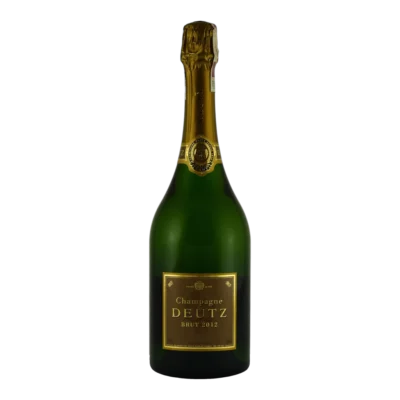
Vintages from the large houses and magnums are best for laying down for a few years. Moët & Chandon Grand Vintage 2016 can be opened straight away or kept for a future anniversary. Deutz (pronounced duhts) from Aÿ (pronounced ah-EE) keeps its wines in the cellar longer than the regulations require, and its Brut Millésimé (pronounced mee-lay-zee-may) 2015 is also suitable for laying down. If you are looking for a specific year, such as a birth or wedding year, take a look at the ranking of vintage Champagnes. For an occasion a week or a month away, a non-vintage Champagne such as Brut Impérial will do perfectly well (pronounced broot am-pay-ree-AL) from the house Moët & Chandon.


