
Brut, Extra Dry, Demi-Sec: how much sugar is in Champagne
Brut on a Champagne label means that a litre of wine contains less than 12 grams of sugar, in other words the Champagne is dry. It is one of seven terms EU law uses to describe the sweetness of sparkling wines: from Brut Nature (below 3 g/l) to Doux (above 50 g/l). Around 90% of Champagnes are Brut, but the neighbouring terms can be misleading, because Extra Dry is sweeter than Brut.

What does Brut mean on a Champagne label?
Brut means a Champagne with less than 12 grams of sugar per litre; the Polish version of the EU rules calls such wine “very dry”.
In French, Brut means something unworked or raw, like raw wool or rough timber. On a bottle of Champagne, however, the word says nothing about a raw taste. It is the name of one of the sugar levels listed in Commission Delegated Regulation (EU) 2019/33. Its Article 47 requires every sparkling wine label to carry one of the terms from Annex III (Part A), and the Comité Champagne, the organisation of Champagne growers and houses, includes this information in the list of mandatory particulars on a Champagne label.
In Champagne, Brut is the standard. According to the Comité Champagne, around 90% of all Champagnes have this sugar level, so a shop's Champagne shelf is in practice a shelf of Bruts.
Where does the sugar in Champagne come from?
Sugar is added at the very end of production, with the dosage liqueur (liqueur d'expédition pronounced lee-kur dex-pay-dee-syon).
Champagne goes through two fermentations. The first, in a vat, turns grape juice into wine and consumes all the sugar: afterwards, as the Comité Champagne writes, none should remain in the wine. The second fermentation takes place in the bottle and creates the bubbles. The wine then rests on the lees of dead yeast, and once the sediment has been removed (this is disgorgement), a little dosage liqueur, that is wine with sugar, is added to the bottle. The French call the dose itself dosage.
The amount of liqueur determines which word appears on the label. The producer decides this alone, separately for each cuvée (pronounced koo-VAY). More on this stage in our article on disgorgement and dosage.
The sugar scale in Champagne: a table
The seven terms, from least to most sweet, are: Brut Nature (pronounced broot na-TEWR), Extra Brut, Brut, Extra Dry, Sec, Demi-Sec (pronounced duh-MEE SEK) and Doux.
| On the label | In the Polish version of the rules | Sugar per litre | Sugar in a 125 ml glass |
|---|---|---|---|
| Brut Nature, pas dosé, dosage (pronounced doh-sahzh) zéro | Brut Nature | below 3 g, no added sugar | under 0.4 g |
| Extra Brut | ekstra wytrawne (extra dry) | 0-6 g | up to 0.75 g |
| Brut | bardzo wytrawne (very dry) | under 12 g | under 1.5 g |
| Extra Dry | wytrawne (dry) | 12-17 g | 1,5-2,1 g |
| Sec | półwytrawne (medium-dry) | 17-32 g | 2,1-4 g |
| Demi-Sec | półsłodkie (medium-sweet) | 32-50 g | 4-6,3 g |
| Doux | słodkie (sweet) | over 50 g | above 6.3 g |
The thresholds come from Annex III of Regulation 2019/33; we calculated the last column for a typical 125 ml glass. Two rules in Article 47 explain why the limits overlap. If a wine fits two categories (for example, a Champagne with 5 g/l is both Extra Brut and Brut), the producer chooses one of them. The actual sugar content may also differ from the declared figure by no more than 3 g/l. Brut Nature has an additional condition: no sugar may be added to it after the second fermentation.
Why is Extra Dry sweeter than Brut?
Because in the regulations Extra Dry begins exactly where Brut ends: from 12 to 17 g of sugar per litre.
English dry and the French Sec mean “dry”, so intuition suggests that Extra Dry and Sec are the driest Champagnes. The opposite is true. The Polish version of the regulation shows this ladder well: Brut is “very dry”, Extra Dry is plain “dry”, and Sec is already “medium-dry”. Demi-Sec, literally “half-dry”, is called outright “medium-sweet” in Polish law.
How much sugar do well-known Bruts have?
The Bruts from the great houses whose figures we checked have 7-8 g of sugar per litre, which puts them in the middle of the category.
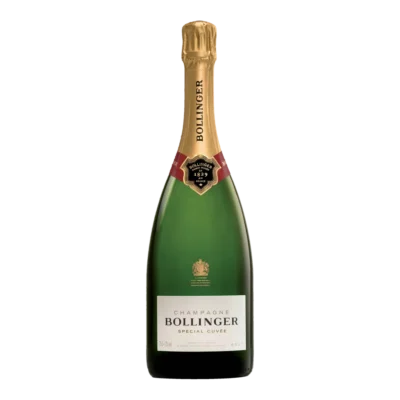
A few figures from the producers' data. Moët & Chandon (pronounced mo-et ay shon-don) gives 7 g/l for Impérial, its non-vintage Brut. Bollinger (pronounced bol-an-zhay) for Special Cuvée (pronounced spay-SYAL koo-VAY) gives 7-8 g/l, while Ruinart (pronounced rwee-NAR) for Blanc de Blancs (pronounced blahn duh BLAHN) gives 7 g/l. All three are Bruts, yet they taste different, because we perceive sweetness together with acidity, fruit and the age of the wine. Ruinart, made only from Chardonnay, will seem crisp, and Bollinger, with 60% Pinot Noir, fuller, although their sugar levels are similar.

One house can have bottles from both ends of the scale. Moët (pronounced mo-ET) alongside Impérial it sells Nectar Impérial (pronounced nek-TAR am-pay-ree-AL) with 45 g/l, which the house itself describes as a Demi-Sec. Laurent-Perrier (pronounced lor-ahn pe-ree-ay) has made Ultra Brut with no dosage at all since 1981, alongside a classic Brut.


Brut or Demi-Sec: which to choose?
Brut for a toast, as an aperitif and with food; Demi-Sec with desserts and sweet-and-savoury dishes.
The Comité Champagne calls non-vintage Brut a wine for any occasion and recommends it both as an aperitif and with the main course, from the start to the end of dinner. It describes sweeter Champagnes, from Sec to Doux, as rounder, with pronounced fruit, and advises serving them with desserts and with dishes that combine sweet and salty. If you are buying one bottle for a party and do not know your guests' taste, Brut is the safer choice. If you know your guests find Brut too sharp, you will find suggestions in our article on sweet Champagne: Demi-Sec, Nectar and Ice.
We have arranged the Bruts, from bestsellers to vintages and prestige cuvées, by style and class in the ranking the best Champagne.
Where on the label should you look for the word Brut?
Usually on the front label, under the name of the house or cuvée, sometimes only on the back label.
The sugar level usually appears just below the brand or next to the cuvée name, in smaller type. Some houses build it into the name (Brut Impérial pronounced broot am-pay-ree-al, Brut Réserve pronounced broot ruh-ZAIRV, Ultra Brut), others print just the word on the back label. If the producer also gives the exact number of grams or the disgorgement date, you will usually find them on the back of the bottle. A full description of the label is in our guide to the Champagne label, step by step.


