


Jacquesson
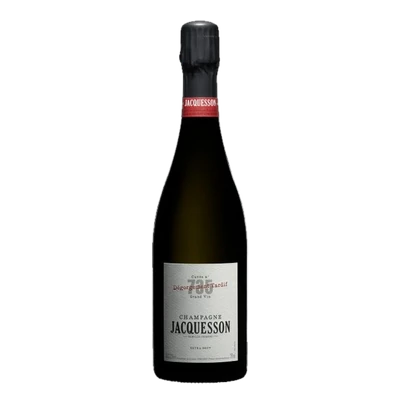
pronounced zhak-SOHNOne of the oldest houses in Champagne, where Joseph Krug learnt his trade and Adolphe Jacquesson patented the wire cage for the cork. Since 2000 it has made Champagne differently from everyone else: instead of a consistent Brut, a different, numbered cuvée every year.
See the bottlesAvailable at SZAMPAN.com.pl
1 Champagne. Formats and packaging of the same bottle are on its page, not listed separately.
House signature
A number instead of Brut
Since 2000 the house has made a different blend every year, based mainly on a single harvest, and numbers it according to the cellar book kept since 1898.
The muselet patent
Adolphe Jacquesson patented the wire cage for the cork that every Champagne producer uses today.
Joseph Krug's school
Joseph Krug spent eight years learning the trade at Jacquesson before founding his own house in Reims in 1843.
At a glance
- Founded
- 1798
- Based in
- Dizy (Grande Vallée de la Marne); founded in Châlons-sur-Marne
- Type
- house (négociant-manipulant)
- Owner
- Artémis Domaines (the Pinault and Henriot La Rouzière families), since late 2022
- President
- Jean Garandeau (managing director)
- Chef de cave
- no publicly named chef de cave; Yann Le Gall (Wine Director) is responsible for the wine, Mathilde Prier for the vineyards
- Vineyards
- 36 ha of grand cru and premier cru (Avize, Aÿ, Oiry, Dizy, Hautvillers, Champillon), of which 18 ha are owned; organic since 2010
- Production
- approx. 250,000-350,000 bottles a year
- House style
- numbered cuvées from the 700 series instead of a classic non-vintage Brut, fermentation in large casks, first juice only, very low dosage
Data checked: October 2026.
History
- 1798
Châlons and a medal from the emperor
Claude and Memmie Jacquesson founded the house in Châlons-sur-Marne. They carved cellars into the slope of Mont Saint-Michel, at the level of the Marne Valley. Fame came with the rumour that it was Napoleon's favourite Champagne and that he had awarded the house a gold medal for its cellars. In 1829 Jacquesson absorbed the Juglar house, and in 1832 it took the name Jacquesson & Fils.
- 1834
The accountant from Mainz
In 1834 Joseph Krug, the son of a butcher from Mainz, joined Jacquesson. For eight years he worked as an accountant, travelled around Europe and learned the art of blending, and according to the house he acted as chef de cave. In 1843 he founded his own house, Krug, in Reims. Adolphe Jacquesson died in 1876 in the Paris flat of Paul Krug, the son of his former employee.
- 1844
Adolphe and the muselet
Memmie's son Adolphe, together with Dr Jules Guyot, modernised Champagne production. In 1844 the house patented the muselet, the wire cage that holds the cork, still in use today. By 1867 Jacquesson was selling a million bottles a year. Between 1863 and 1866 Eugène Jacquesson built a château opposite the cellars to designs by Viollet-le-Duc.
- 1925
Decline and rescue
The deaths of Adolphe's two sons and of Adolphe himself brought the golden age to an end. The house changed hands several times until, in 1924-1925, it was bought by the stockbroker Léon de Tassigny, who added 11 ha in Avize and Oiry. In 1974 Jean Chiquet moved the house to Dizy, and from 1990 it was run by his sons Jean-Hervé and Laurent.
- 2000
The 700 Manifesto
Until 1999 Jacquesson made a standard non-vintage Brut. In 2000 the Chiquet brothers abandoned the idea of a consistent house style and announced the “Manifeste 700”: every year the best possible blend, based mainly on a single harvest. The first was Cuvée 728 from the 2000 harvest, released in 2004. The number is the next entry in the cellar book, counted from Cuvée No. 1 of 1898, made for the house's centenary.
- 2022
Pinault in Dizy
In February 2022 the Pinault family's Artémis Domaines bought a 33% stake, and in December the whole house. The Chiquet brothers had no successors and wanted to hand Jacquesson over “into the best possible hands”. Jean-Hervé stayed on the supervisory board, and both still sell grapes from their own vineyards to the house. The house is run by Jean Garandeau.

People
Adolphe Jacquesson
He ran the house during its golden age, worked with Dr Guyot and patented the muselet in 1844. He employed the young Joseph Krug.
Joseph Krug
A German accountant who learned the trade and the art of blending at Jacquesson. In 1843 he founded the Krug house in Reims.
Jean-Hervé and Laurent Chiquet
Creators of the 700 series and of the principle “pragmatism is compulsory, compromise is forbidden”. They switched to organic farming and single-plot wines, and after selling the house became its grape suppliers.
Jean Garandeau
He came from Artémis Domaines, where he was responsible for sales and marketing. He has run the house since the change of ownership.
House style
Jacquesson's vineyards lie in two areas: the Côte des Blancs (Avize, Oiry) and the Grande Vallée de la Marne (Aÿ, Dizy, Hautvillers, Champillon). The house has been certified organic since 2010; it ploughs, leaves grass between the rows and prunes the vines short. Only the first juice from traditional presses goes into the wine, and the wines ferment and age in large oak casks.
Each Cuvée 700 ages for more than four years, and the same blend is also released as a Dégorgement Tardif version, which spends further years in the cellar under cork. Dosage is very low, usually 1-5 g/l. On the back label the house gives the number of bottles, the month of disgorgement and the dosage. Plots that produced an exceptional wine in a given year are bottled separately as vintage wines.
Key cuvées
- Cuvée 749
- The latest release in the 700 series, based on the 2021 harvest (72%) with reserve wines from cuvées 743-748, Chardonnay-led, dosage 2 g/l.Serving: oysters, scallops, grilled fish, sushi.
- Cuvée 744 Dégorgement Tardif
- A blend based on 2016, 92 months on the lees under cork.Serving: lobster, chicken in a creamy mushroom sauce, aged Comté.
- Avize Champ Caïn
- Blanc de Blancs from a plot in Avize planted in 1962; the 2015 vintage was disgorged in February 2025, dosage approx. 1 g/l.Serving: caviar, sole cooked in butter, langoustines.
- Dizy Corne Bautray
- A single-plot wine from Dizy, named in the manifesto alongside Champ Caïn and Vauzelle Terme as a plot worthy of its own bottling.Serving: roast poultry, veal, mushroom dishes.
- Dizy Terres Rouges
- A vintage wine from a plot in Dizy, one of five new releases in the 2025 programme.Serving: duck, pigeon, mature cheeses.
Curiosities
- Joseph Krug worked at Jacquesson for eight years before founding his own house in 1843. Adolphe Jacquesson died in the flat of Paul Krug, the son of his former employee. source
- In 1844 Adolphe Jacquesson patented the muselet, the wire cage for the cork used by every Champagne producer in the world. source
- In 2010 the diver Christian Ekström found 168 bottles of Champagne on a wreck near the Åland Islands in the Baltic. Some of them came from the house of Juglar, which had been part of Jacquesson since 1829. source
- The number on a Cuvée 700 label is the next entry in a cellar book kept since 1898. So Cuvée 728 was the 728th blend since the house's centenary. source
- In 1867 Jacquesson sold a million bottles - several times more than it sells in a year today. source
- Château Jacquesson in Châlons, built in 1863-1866 to designs by Viollet-le-Duc, has been a listed monument since 1980. Today it houses flats. source
- Italy has long been Jacquesson's largest export market: about 12% of production. source
- One article of the house manifesto reads: “Pragmatism is compulsory, compromise is forbidden”, and another: “To reveal the wine rather than make it”. source
Jacquesson was Napoleon's favourite Champagne.
This is the rumour on which the house built its fame in the 19th century. Jacquesson itself now describes it as a “persistent rumour”, not a fact. The Champagne historian Richard Juhlin mentions a gold medal for the cellars, but no one has produced a document confirming the emperor's taste. source
“Why aim for the average when you can achieve excellence?”


Frequently asked questions
What does the number on a Jacquesson bottle mean?
It is the next entry in the cellar book, counted from Cuvée No. 1 of 1898, the house's centenary. The first, Cuvée 728, came from the 2000 harvest, and the latest, 749, is 72% based on the 2021 harvest. On the back label the house gives the number of bottles, the month of disgorgement and the dosage.
How does Cuvée 700 differ from Dégorgement Tardif?
It is the same blend, but the Dégorgement Tardif version stays in the cellar under cork for several years longer. Cuvée 744 DT, based on 2016, spent 92 months on the lees. It is more mature and complex, better with food than as an aperitif.
Who owns Jacquesson?
Since December 2022, the Pinault family's Artémis Domaines. The brothers Jean-Hervé and Laurent Chiquet, who ran the house from 1990 and created the 700 series, had no successors; they still sell grapes to the house. The managing director is Jean Garandeau.
Was Jacquesson Napoleon's favourite Champagne?
So went the rumour on which the house built its fame in the 19th century. Today Jacquesson itself calls it a “persistent rumour”, and no one has produced a document confirming the emperor's taste.
What did Jacquesson invent?
The muselet, the wire cage that holds the cork in a Champagne bottle; Adolphe Jacquesson patented it in 1844. In 1867 the house was selling a million bottles a year. Some of the Champagnes found in 2010 on a wreck near the Åland Islands came from the house of Juglar, which had belonged to Jacquesson since 1829.
Other houses
All houses Moët & Chandonpronounced mo-ET ay shahn-DOHN50 bottles
 Dom Pérignonpronounced dom peh-ree-NYOHN27 bottles
 Bollingerpronounced boh-lan-ZHAY19 bottles
 Krugpronounced kroog13 bottles
 Charles Heidsieckpronounced sharl ED-sik10 bottles
 Veuve Clicquotpronounced vuhv klee-KOH11 bottles
- Marguetpronounced mar-GAY10 bottles
- J-M Sélèquepronounced zhee em seh-LEK10 bottles
 Louis Roedererpronounced lwee ROH-duh-rer9 bottles
 Lansonpronounced lahn-SOHN10 bottles
 Deutzpronounced duhts10 bottles
 Laurent-Perrierpronounced loh-RAHN peh-ree-AY8 bottles
Sources
- Champagne Jacquesson - Champagne House
- Champagne Jacquesson - Manifeste des 700
- Champagne Jacquesson - home page
- Wikipedia FR - Champagne Jacquesson & Fils
- Wikipedia EN - Jacquesson
- Wikipedia EN - Krug (Champagne)
- Wikipedia FR - Château Jacquesson
- The Drinks Business (2022) - Pinault family acquires Champagne Jacquesson
- Quotidiano.net (2026) - Champagne Jacquesson lancia due nuove cuvée
- Cellarhand - Jacquesson 739: the numbers tell a story
Photos: G.Garitan (scan), CC BY-SA 4.0 (Wikimedia Commons); unknown, public domain (Wikimedia Commons); Artvill, CC BY-SA 4.0 (Wikimedia Commons); G.Garitan, CC BY-SA 4.0 (Wikimedia Commons).


