


Drappier
pronounced drah-pee-AYOne of the largest independent houses in the Aube, and one of the most persistent experimenters in Champagne: Champagne with no added sulphur, wine aged on the seabed, bottles from a quarter-bottle to 30 litres. And on top of that, General de Gaulle's Champagne.
See the bottlesAvailable at SZAMPAN.com.pl
2 Champagnes. Formats and packaging of the same bottle are on its page, not listed separately.

House signature
The Cistercian cellar
In Urville there is a cellar carved out by the monks of Clairvaux, where the house keeps its oldest vintages and largest bottles.
“Père Pinot”
In the 1930s Michel Drappier's grandfather was the first in the area to go back to Pinot Noir, which today covers around 70% of the house's vineyards.
Old varieties
Drappier grows all eight historic Champagne grape varieties, including the rare Arbane and Petit Meslier.
At a glance
- Founded
- 1808
- Based in
- Urville (Côte des Bar, Aube); cellars also in Reims
- Type
- a family house (négociant-manipulant)
- Owner
- the Drappier family
- President
- Michel Drappier
- Chef de cave
- Hugo Drappier (vineyard and oenology, since 2016)
- Vineyards
- around 62-70 ha of its own, all farmed organically, plus around 50 ha of contract vineyards
- Production
- around 1.5-1.6 million bottles a year
- House style
- Pinot Noir (around 70% of the vineyards), low dosage, minimal sulphur, the eight old Champagne grape varieties
Data checked: October 2026.
History
- 1152
The monks of Clairvaux
Vines grew on the slopes of Urville as early as Gallo-Roman times, but it was Saint Bernard who brought order to the vineyards. According to the house, in 1116 he brought Morillon Noir, the ancestor of Pinot Noir, from Burgundy, and in 1152 the Cistercians of Clairvaux carved out a cellar in Urville. After the Revolution Napoleon turned the abbey into a prison. The Drappiers, who lived next door, bought the cellars after the Second World War. The house's oldest vintages and largest bottles are kept here today.
- 1808
A cloth merchant from Reims settles in Urville
The family tree begins with Rémy Drappier, a cloth merchant from Reims born in 1604, who traded cloth like Nicolas Ruinart. In 1808 his descendant François settled in Urville and began farming a few hectares of vines. The house has not changed hands since.
- 1930
“Father Pinot”
In the early 1930s Georges Collot, Michel Drappier's maternal grandfather, was the first in the canton to replant Pinot Noir. His neighbours mocked him and nicknamed him “Père Pinot”. Today the grape covers around 70% of Drappier's vineyards and most of the vineyards in the Aube.
- 1952
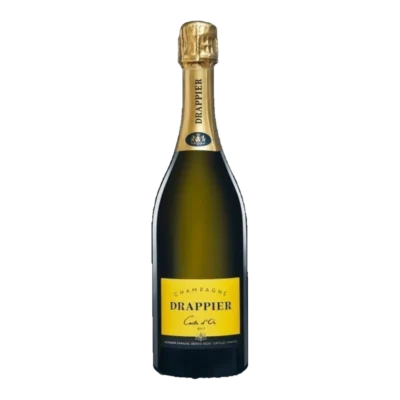
The yellow label
André and Micheline Drappier created Carte d'Or with its yellow label. The colour is a nod to quince jelly: according to Michel, sommeliers in the 1960s detected a hint of it in Drappier's Champagne. After the 1957 frost, which destroyed 95% of the harvest, André planted the hardier Meunier, and in 1968 Micheline came up with a rosé Champagne made entirely from Pinot Noir.
- 1965
A customer from Colombey
In 1965 Drappier's Pinot Noir found its way onto General de Gaulle's table at La Boisserie in Colombey-les-Deux-Églises, a dozen or so kilometres from Urville. The General became the house's most famous customer and also served this Champagne at official receptions. Cuvée Charles de Gaulle was created in 1990, for the 50th anniversary of the Appeal of 18 June.
- 1979
Michel and the eighth generation
Since 1979 the wine has been in the hands of Michel Drappier. In 1988 the family bought deep chalk cellars in Reims, dug in the time of Napoleon III. Since 2016 the eighth generation has worked at the house: Charline runs sales, Hugo the vineyard and cellar, and Antoine farms some of the vineyards with a draught horse. André Drappier died in March 2025 at the age of 99.
- 2026
The Élysée Palace and a new cellar
On 14 July 2026 Grande Sendrée 2012 was served at a banquet at the Élysée Palace, and a month earlier the 2015 vintage was poured at the G7 summit in Évian. The 2026 harvest began on 19 August, the earliest in the house's history. In Urville a cellar is being built that is meant to stay cool and humid without using energy, and in the historic building of the former Counts of Champagne the family is planning a small hotel with a restaurant for 2027.

People
Michel Drappier
The seventh generation. He has turned Drappier into a laboratory: Champagne without sulphur, bottles on the seabed, old grape varieties, carbon neutrality. He likes to say that in Urville he has “the grape of Chambertin, the soil of Grand Cru Chablis and the climate of Champagne”.
Hugo Drappier
He runs the vineyard and cellar. He is responsible for a series of experimental cuvées, including Père Pinot 2, made from four Pinot varieties with no added sulphur. He calls Arbane “the worst grape variety to grow”.
Charline and Antoine Drappier
Charline (born 1989) is taking over sales. Antoine (born 1996) ploughs some of the vineyards with a horse and looks after a vegetable garden, an old orchard and farm animals.
Georges Collot
In the 1930s he was the first in the area to go back to Pinot Noir, and was mocked for it. History proved him right.
House style
Urville lies on the Côte des Bar, around 160 km south of Épernay, at an altitude of around 380 m, on Kimmeridgian limestone, the same as in Chablis. Pinot Noir gives ripe, fruity, full-bodied wines here, which you can taste in Carte d'Or and Brut Nature. All of the house's vineyards are farmed organically, and the house has been certified carbon neutral for years.
Drappier uses little dosage and as little sulphur as possible. In 2009 Brut Nature Sans Soufre was presented as the first Champagne with no added sulphur. The house grows all eight historic Champagne grape varieties, including Arbane and Petit Meslier, planted by Michel in 2000, as well as Fromenteau (Pinot Gris) and Blanc Vrai (Pinot Blanc). The second fermentation takes place in the bottle in every size, right up to the 30-litre Melchizedek.
Key cuvées
- Carte d'Or Brut
- The house Champagne since 1952, Pinot Noir-led, with a yellow label. Ten years ago it accounted for 80% of sales, today less than half.Serving: as an aperitif, with roast chicken, pâté and Langres cheese.
- Brut Nature (Zéro Dosage)
- Pinot Noir with no dosage. According to The Drinks Business, one of the house's fastest-growing wines; there is also a version with no added sulphur.Serving: oysters, sushi, fish tartare, goat's cheese.
- Grande Sendrée
- A prestige vintage from a plot covered in ash after the fire in Urville in 1836. The spelling with an “s” is a mistake from the land register.Serving: lobster, guinea fowl with mushrooms, veal, Comté.
- Quattuor
- Blanc de quatre blancs: 25% each of Arbane, Petit Meslier, Blanc Vrai and Chardonnay, in steel, no oak.Serving: scallops, grilled fish, asparagus, seafood.
- Trop m'en faut
- 100% Fromenteau from a single 1.8 ha plot ploughed by horse. The name is a play on words, because the Comité Champagne would not allow the name of the grape on the label.Serving: roast poultry, terrine, mature cheeses, Asian food.
- Cuvée Charles de Gaulle
- A tribute to the house's most famous customer, created in 1990. Pinot Noir with a little Chardonnay.Serving: beef, duck, Comté, a celebration dinner.
Curiosities
- Drappier sells Carte d'Or in 12 sizes, from 0.2 l to the 30 l Melchizedek. Michel Drappier had the Melchizedek bottle specially made in Italy; it is around 1.10 m tall and weighs 52 kg, and the house built a reinforced oak riddling rack for it. source
- The Immersion series spent two years at a depth of around 30 m in the bay of Saint-Malo. Michel Drappier compares ageing in the sea to cooking meat in water instead of frying it in a pan. source
- Around 3 ha of Arbane grow in Champagne, of which around half a hectare belongs to Drappier. source
- In 1957 frost destroyed 95% of Drappier's harvest. After that disaster André planted Meunier, which copes better with spring frosts. source
- The 2026 harvest began in Urville on 19 August, the earliest in the house's more than 200-year history. Hugo Drappier called the vintage exceptional. source
- anecdote Michel Drappier recalls that 30 years ago Champagne from the Aube was hard to sell in Reims, and today it is fashionable there. source
- rumour The house's range has grown to around 25 cuvées. According to Tom Hewson, the marketing department reportedly frowns on such a long list of wines. source
- Micheline's 1968 rosé Champagne, made entirely from Pinot Noir, was a novelty at the time. Today the Rosé de Saignée, macerated on the skins for two days, is served at the Élysée Palace. source
General de Gaulle drank Cuvée Charles de Gaulle.
The General died in 1970. From 1965 he drank pure Pinot Noir from Drappier, and the house only created the cuvée named after him in 1990, for the 50th anniversary of the Appeal of 18 June. Today's version also has a little Chardonnay. source
“We have the grape of Chambertin, the soil of Grand Cru Chablis and the climate of Champagne.”

Frequently asked questions
Did General de Gaulle drink Drappier Champagne?
Yes, from 1965 Drappier's Pinot Noir was served at the General's table in Colombey-les-Deux-Églises, a dozen or so kilometres from Urville, and at official receptions. However, the house only created Cuvée Charles de Gaulle in 1990, twenty years after the General's death.
What is Champagne with no added sulphur?
Champagne to which the winemaker has not added sulphur dioxide, which is normally used to protect the wine. In 2009 Drappier's Brut Nature Sans Soufre was presented as the first such Champagne. It is a Pinot Noir with no dosage, pure and fruity, and needs to be kept cool.
Which Drappier should you start with?
Carte d'Or with the yellow label, the house Champagne since 1952, Pinot Noir-led. The colour is a nod to the quince jelly that sommeliers detected in this wine. If you prefer your Champagne completely dry, go for Brut Nature.
Where is Urville and what is the Côte des Bar?
Urville lies in the Aube on the Côte des Bar, around 160 km south of Épernay, at an altitude of around 380 m. The soil is Kimmeridgian limestone, the same as in Chablis, and Pinot Noir gives ripe, fruity, full-bodied wines here. Drappier is one of the largest independent houses in the Aube.
What bottle sizes does Drappier come in?
Carte d'Or comes in 12 sizes, from 0.2 l to the 30-litre melchizedek, which weighs 52 kg and is around 1.10 m tall. The second fermentation takes place in the bottle in every size, including the largest, for which the house built a reinforced oak riddling rack.
Other houses
All houses Moët & Chandonpronounced mo-ET ay shahn-DOHN50 bottles
 Dom Pérignonpronounced dom peh-ree-NYOHN27 bottles
 Bollingerpronounced boh-lan-ZHAY19 bottles
 Krugpronounced kroog13 bottles
 Charles Heidsieckpronounced sharl ED-sik10 bottles
 Veuve Clicquotpronounced vuhv klee-KOH11 bottles
- Marguetpronounced mar-GAY10 bottles
- J-M Sélèquepronounced zhee em seh-LEK10 bottles
 Louis Roedererpronounced lwee ROH-duh-rer9 bottles
 Lansonpronounced lahn-SOHN10 bottles
 Deutzpronounced duhts10 bottles
 Laurent-Perrierpronounced loh-RAHN peh-ree-AY8 bottles
Sources
- Champagne Drappier - Histoire de famille
- Wikipedia FR - Champagne Drappier
- Wine Business International - Champagne Drappier, Pinot specialists for 200 years
- The Drinks Business (2026) - Champagne Drappier served at presidential banquet
- The Drinks Business (2026) - How Champagne Drappier is cementing its position in the Aube
- The Drinks Business (2024) - How Champagne Drappier is looking back to face the future
- The Drinks Business (2018) - Drappier: sea ageing Champagne
- Tom Hewson, Six Atmospheres - The Drappier way
- Paris Gourmand - Champagne Drappier, mini ou maxi
- Wikipedia EN - Drappier (Decanter 2009: the first Champagne without sulphur)
Photos: Avp10200, CC BY-SA 4.0 (Wikimedia Commons); Olivier Lemoine (Photo-Terroir.fr), CC BY-SA 4.0 (Wikimedia Commons); Phsmet, CC BY 4.0 (Wikimedia Commons).


