
What to serve with Champagne, or why strawberries are not the best idea
Brut Champagne is best served with salty snacks, seafood, sushi, fish and poultry, because its acidity and bubbles refresh the mouth after rich dishes. With sweet desserts, including strawberries with sugar or cream, it is better to choose a Demi-Sec Champagne: with sweet food a dry Brut tastes sour and flat. Below is a table of styles and dishes based on the Comité Champagne and the Champagne houses.

What to serve with Champagne
Brut Champagne is best served with salty, rich and crunchy snacks, fish, seafood and poultry, leaving sweet desserts to Demi-Sec Champagnes (pronounced duh-MEE SEK).
Champagne has marked acidity and bubbles, so it “cleanses” the palate well after rich and creamy dishes. This is described by a classic rule of food and wine pairing: the crisp acidity of the wine cuts through the creaminess of a sauce and refreshes the mouth. The Comité Champagne, the organisation representing the growers and Champagne houses, calls non-vintage Brut a wine that “goes with everything” and recommends it from the aperitif to family celebrations such as christenings and weddings.
The problem only arises with sweetness. A dry Champagne next to a sweet dessert tastes sour and thin, and the sweet dish loses its flavour. Hence the strawberry trap in the title.
Champagne and strawberries: why it is not the best idea
Strawberries with cream or in chocolate are sweeter than Brut Champagne, and sweet food makes a dry wine seem sour and flat.
Food and wine pairing has a simple rule: the wine should be at least as sweet as the dessert it is served with. Food and wine pairing handbooks give an example involving Champagne directly: a vintage Brut served with a sweet wedding cake tastes sour and weak, and the cake loses its flavour. Strawberries on their own are not very sweet, but served with sugar, whipped cream or chocolate they act like a dessert.
There are two ways out. The first: match the strawberries with a sweeter Champagne. The Comité Champagne recommends Demi-Sec and Doux Champagnes precisely for desserts, giving a strawberry and pistachio tart as an example. The second: instead of a white Brut, serve a rosé Brut Champagne and fresh strawberries without sugar; the red fruit notes in the wine then go well with the fruit.
Which Champagne with which dish
Light Chardonnay-based Champagnes go with seafood and fish, Pinot Noir-based ones with meat and poultry, rosés with salmon, duck and red fruit, and sweeter ones with desserts and spicy Asian food.
For each style the Comité Champagne gives one dish that pairs with it best. The Champagne houses publish similar suggestions for their own wines. We have gathered them in one table:
| Champagne style | What to serve | Example bottle |
|---|---|---|
| Non-vintage Brut | aperitif, vegetable tempura, prawns, sushi, fish in butter sauce, gougères (cheese puffs) | Deutz (pronounced duhts) Brut Classic, Moët & Chandon Brut Impérial (pronounced broot am-pay-ree-AL) |
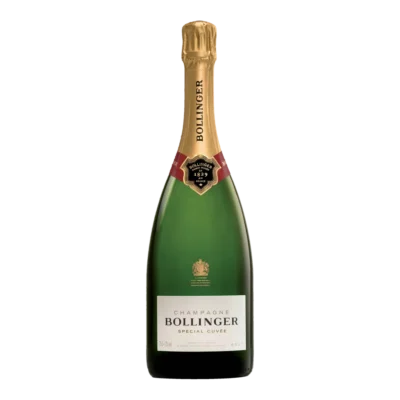
| Pinot Noir-led Brut | roast chicken, smoked salmon, pâté, mature Comté cheese | Bollinger Special Cuvée (pronounced bol-an-zhay spay-syal koo-vay) |
| Blanc de Blancs (pronounced blahn duh BLAHN) (from Chardonnay) | scallop ceviche, oysters, seafood, delicate fish | Ruinart Blanc de Blancs (pronounced roo-ee-nar blahn de blahn) |
| Blanc de Noirs (pronounced blahn duh NWAR) (from black grapes) | roast suckling pig, roasts, stews | Taisne Riocour Blanc de Noirs (pronounced ten ree-oh-koor blahn de nwahr) |
| Rosé | roast poultry, salmon, tuna, duck, red fruit | Ruinart Rosé, Moët & Chandon Rosé Impérial (pronounced roh-ZAY am-pay-ree-AL) |
| Brut Nature (pronounced broot na-TEWR), extra brut | ostrygi, kawior, sashimi | Laurent-Perrier (pronounced lor-ahn pe-ree-ay) Ultra Brut |
| Vintage | prawns with capers and garlic butter, lobster, turbot | Gosset (pronounced goh-SAY) Grand Millésime (pronounced mee-lay-ZEEM) |
| Demi-sec, doux | desserts, strawberry tart, sweet-and-sour dishes | Moët & Chandon Nectar Impérial |
The suggestions for the styles come from the Comité Champagne, and those for specific bottles from the houses' own materials: Bollinger recommends Special Cuvée with roast chicken and Comté, Deutz Brut Classic with prawns and fish in butter sauce, and Ruinart its Rosé with salmon, tuna and duck.


Champagne with sushi, oysters and seafood
Champagne goes well with sushi and oysters, ideally a dry one: Brut, Extra Brut or Brut Nature.
Salty seafood and delicate raw fish are best suited to a crisp wine with little sugar. Moët & Chandon recommends its Brut Impérial with sushi and seafood salads, and Laurent-Perrier its Ultra Brut, a Champagne with no added sugar, with oysters, caviar and sashimi. The Comité Champagne attributes mineral notes, associated with chalk, flint and shells, to Blanc de Blancs Champagnes and suggests scallop ceviche with them. With sushi, watch out for sweet sauce and a lot of wasabi, which can overwhelm the wine.
Champagne with meat, cheese and everyday food
Fuller-bodied Champagnes work better with meat and cheese: Pinot Noir-led, Blanc de Noirs, rosé and vintage.
The Comité Champagne describes Blanc de Noirs as wines with “power, density and structure” and recommends them with meat, roasts and braised dishes, and rosé Champagnes with roast poultry. The cooperative H. Blin (pronounced ash blan) from Vincelles calls its Champagnes “bistronomic”, i.e. made for food, and suggests them with tapas, ribs and baked Brie. From Polish cooking, fried and rich dishes go well with Brut Champagne: herring in cream, potato pancakes with salmon, fried carp. The acidity and bubbles refresh the mouth after the fat.
For cheese, it is worth choosing hard, mature cheeses such as Comté or Parmesan, or creamy mould-ripened cheeses for fuller Champagnes. Very intense blue cheeses go better with a sweeter Champagne, because the sweetness contrasts with the salt.
Champagne with spicy Asian food
Hot Thai or Sichuan dishes go better with a Champagne that has a touch of sweetness, for example a Demi-Sec, than with a very dry Brut.
Sweetness in wine softens the burn of chillies and spices. The same rule works for sweet-and-sour dishes, for which the Comité Champagne recommends Demi-Sec Champagnes. A good choice here is Nectar Impérial from Moët & Chandon, a Demi-Sec Champagne. More about sweeter Champagnes in our article sweet Champagne: Demi-Sec, Nectar and Ice.

How to serve Champagne with dinner
At a dinner of several courses, start with the lightest Champagne and finish with the fullest or sweetest: Brut Nature or Blanc de Blancs with the starters, Brut or rosé with the main course, Demi-Sec with dessert. Serve Champagne at 8-10 °C, as the Comité Champagne recommends, and for dinner choose a tulip-shaped glass or an ordinary white wine glass, which shows the aroma of the wine better than a flute (more in our article the Champagne glass). Bottles that work at the table in different styles are collected in ranking of the best Champagnes.


